

For years, SEO meant writing for a search box. People typed clipped, keyword-heavy phrases, and websites were built to match them word for word.
That assumption no longer holds. In 2026, close to a third of all search queries are spoken instead of typed, and that share keeps climbing every year. Voice assistants now outnumber people on the planet, embedded in phones, cars, smart speakers, and wearables that people talk to dozens of times a day.
At Enovatorz, we have watched this shift play out directly across our clients’ SEO campaigns. Pages built around natural, conversational language and structured answers are earning voice placements and featured snippets that keyword-stuffed pages simply cannot reach, regardless of how much link-building sits behind them.
This guide breaks down what voice search SEO actually means, why it is growing faster than any other search behaviour right now, and how your business can build a site that voice assistants trust enough to read out loud.
Understanding Voice Search SEO: Beyond Typing Keywords
Voice search SEO is the practice of optimizing content so it can be found, understood, and read aloud by voice assistants like Google Assistant, Siri, and Alexa. It is not a separate discipline from SEO; it is a shift in how content needs to be written and structured.
Consider how the same intent shows up differently depending on how it is searched:
- Typed search: “best turkish restaurant orlando” — three fragments, no verb, no question.
- Voice search: “Where’s a good Turkish restaurant near me that’s open right now?” — a full, natural question, asked exactly like you would ask a friend.
Search engines have to match that second query to a page that answers it directly, ideally in one or two sentences near the top of the content. That is the entire game of voice search SEO: writing the way people actually talk, then structuring the page so an assistant can lift out a clean, spoken answer.
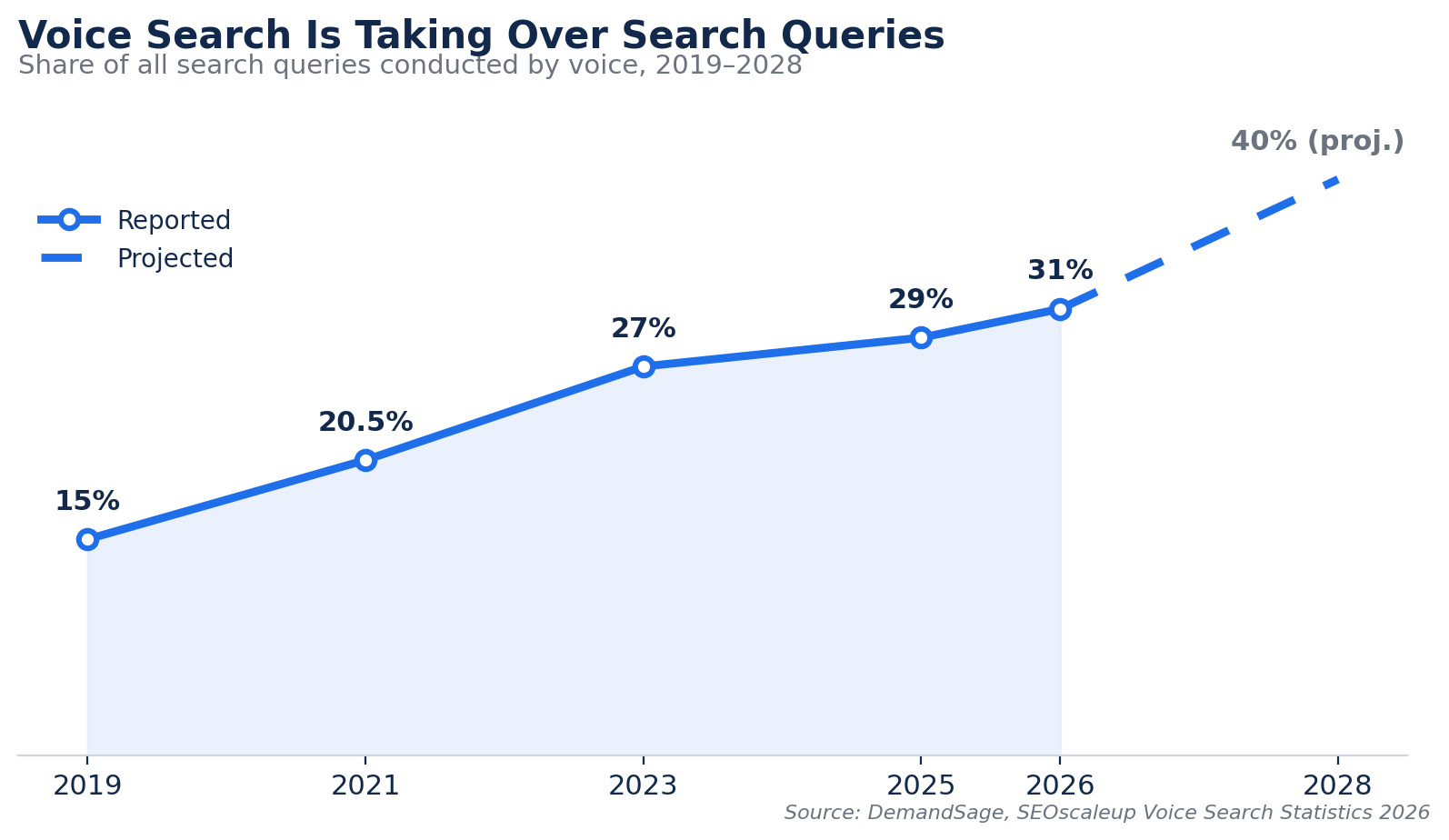
Voice now accounts for roughly 3 in 10 searches, and that share is projected to keep rising through 2028.
The Four Ways People Actually Use Voice
Google’s own research on voice groups spoken input into four categories, and only two of them matter for SEO:
- Recording: dictating a message into WhatsApp or Messenger. Not a search query.
- Dictation: speaking into a keyboard or text editor instead of typing. Also not a search query.
- Commands: short, direct instructions like “play jazz” or “call Mom.” Relevant mainly for app and skill-level optimization.
- Conversational search: full, natural questions asked of Google Assistant, Siri, or Alexa. This is where voice search SEO actually applies.
Knowing the difference matters because it explains why voice SEO covers both head terms (short, competitive keywords like “pizza delivery”) and long-tail, conversational phrases (“where can I get pizza delivered after midnight”). Ranking for both gives you coverage across the full range of how people actually search by voice.
The Fundamental Shift: From Typing to Talking
The rise of voice search reflects deeper technological and behavioural changes in how people access information.
Smart Speakers and AI Assistants Are Now Everywhere
Billions of voice-enabled devices are active worldwide, and the installed base of assistants has already passed the world’s population. Most of that activity still happens on smartphones rather than smart speakers, which means voice optimization and mobile optimization are now effectively the same job.
Local, “Near Me” Intent Dominates
Close to half of all voice searches carry local intent. Assistants answer these queries by pulling directly from business listings, which is why an accurate, complete Google Business Profile has become one of the highest-leverage local ranking factors. This ties directly into local and national SEO strategy, where listing accuracy and structured data now carry as much weight as on-page content.
AI Overviews and Conversational Search
Voice queries and AI-generated answers increasingly come from the same underlying system. Google’s AI Overviews and conversational assistants both pull from authoritative, clearly-structured sources rather than the page with the most backlinks. Understanding how AI visibility intersects with SEO is now essential groundwork for voice optimization, since both reward the same kind of content: direct, well-organized, genuinely useful answers.
Featured Snippets Do Most of the Talking
A large share of spoken voice answers are read directly from a featured snippet or another SERP feature, not the top blue link. Winning the snippet is, in practice, winning the voice answer.
Why Voice Search Matters More Than Ever
The numbers behind this shift are hard to ignore:
- Voice queries have grown from roughly 15% of all searches in 2019 to around 31% today, and are projected to pass 40% by 2028.
- Nearly half of all voice searches have local, “near me” intent.
- Close to 97% of spoken voice answers are pulled from a page already ranking in the top 10 organic results, and most of those from a featured snippet.
- The average spoken voice answer is only about 41 words long, which is why the first sentence of any section carries the most weight.
- Pages that rank well for voice tend to sit around an 8th-grade reading level on the Flesch-Kincaid scale, not a jargon-heavy one.
- Voice-ranking pages average well over 2,000 words overall, even though the spoken answer itself is only a sentence or two.
Put together, these signals describe a very specific kind of page: already ranking, easy to read, and built around a short, quotable answer near the top of a much deeper piece of content.
Building a Voice Search SEO Strategy: A Practical Framework
Winning voice search does not require a separate content strategy from scratch. It requires adjusting your existing pages around six practical habits.
Step 1: Map the Questions People Actually Ask
Start from real, full-sentence questions rather than short-tail keywords. Free tools like AnswerThePublic, Google’s “People Also Ask” box, and the Queries report inside Google Search Console all surface how your audience actually phrases what they need, in their own words.
Step 2: Lead With a Direct Answer, in Plain Language
Answer the core question in the first sentence or two of a section, ideally in around 40 words, since that is close to the average length of a spoken voice answer. Write in short sentences, use everyday pronouns (I, you, we), and avoid jargon. As a quick gut check, run the paragraph through a free tool like Hemingway and aim for roughly an 8th-grade reading level.
Step 3: Structure Content to Win the Snippet
Use clear headings phrased as questions, short paragraphs, and tight bullet lists. This is exactly the shape of content Google tends to lift into featured snippets, and nearly all voice answers come from a page that is already ranking on page one.
Step 4: Add Structured Data, Including Speakable Schema
FAQ and HowTo schema give search engines and assistants an explicit, machine-readable map of your questions and answers. For content you specifically want read aloud by Google Assistant, add Speakable schema, a markup type built for that exact purpose. Plugins like Yoast SEO and Rank Math make adding schema straightforward on WordPress sites without touching raw code.
Step 5: Keep Every Local Listing Accurate, Not Just Google
Hours, address, categories, and services on your Google Business Profile feed directly into local voice answers, but assistants also pull from Bing Places for Business and Yelp. Keep your name, address, and phone number (NAP) identical across all three, since inconsistent listings are one of the most common reasons a business gets skipped for a voice answer it should be winning.
Step 6: Keep Pages Fast and Mobile-First
Since most voice search happens on a phone, page speed and mobile usability are not a side concern. Run your pages through Google PageSpeed Insights or GTmetrix, and treat load-time fixes as core voice SEO work, not a separate technical task.
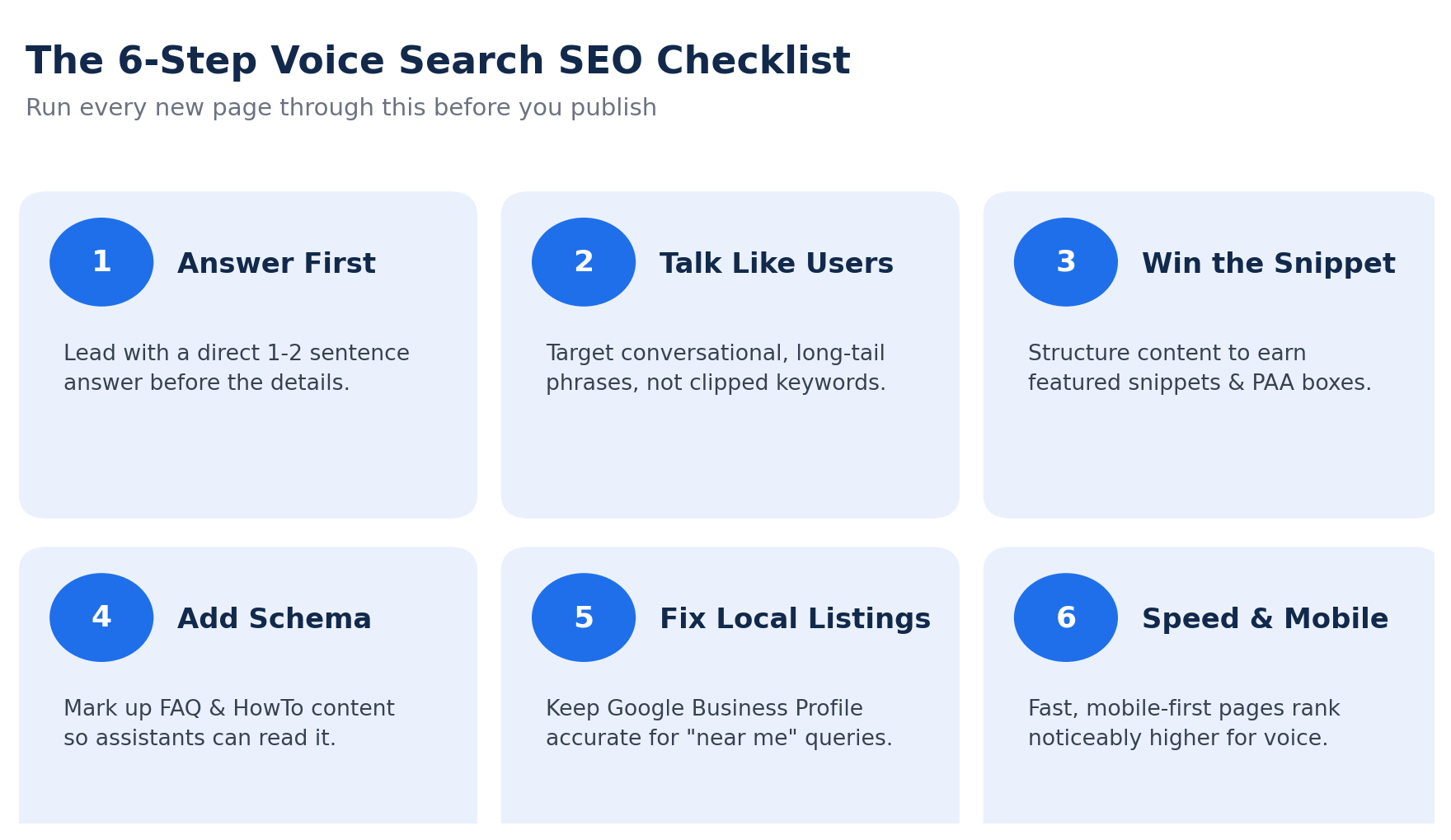
Run every new or existing page through these six checks before you publish.
Voice Search for E-Commerce and Local Businesses
Voice search optimization is not only for informational blogs. It applies directly to commercial and local business websites, just through a different lens on each:
- E-commerce stores: add natural-language product Q&As (“what size should I order,” “is this dishwasher safe”) directly on product and category pages, where assistants can lift them for shopping-related voice queries. Larger catalogs can go a step further by optimizing listings for voice shopping on Amazon and Walmart, or building a dedicated Alexa Skill or Google Action for repeat customers.
- Restaurants and local services: keep hours, menus, and location details identical and accurate everywhere they appear online, since assistants cross-check listings before answering “near me” queries.
- Service businesses: build FAQ sections around the exact questions clients ask on a first call, then mark them up with schema so those answers are ready to be read aloud.
In every case, the underlying job is the same: remove the guesswork for the assistant so it can answer confidently, using your business as the source.
Make Content Accessible, Not Just Optimized
Voice search is also how a large number of people navigate the web at all, including users with visual impairments, mobility challenges, or lower literacy. Optimizing for that audience and optimizing for voice search overlap almost completely:
- Add descriptive alt text to every meaningful image, not just a filename.
- Provide captions and transcripts for video and audio content.
- Use semantic HTML (proper heading levels, list tags, labelled buttons) so assistive tech and voice assistants parse the page the same way.
This is also where voice SEO overlaps with E-E-A-T: content that is genuinely easy to access and understand is exactly what Google’s quality guidelines reward, independent of whether a human reads it or an assistant reads it aloud.
Track and Maintain Voice SEO Over Time
Voice rankings shift as often as regular search results, so treat this as an ongoing habit rather than a one-time project. Revisit your Search Console query data every few months for new question-based queries, refresh existing FAQ sections as customer questions evolve, and re-check your Google Business Profile, Bing Places, and Yelp listings whenever hours or services change.
Common Voice SEO Mistakes to Avoid
- Writing only in clipped, short-tail keywords instead of full conversational questions.
- Burying the direct answer under several paragraphs of introduction.
- Treating Google Business Profile as a one-time setup rather than something to keep updated.
- Skipping schema markup on FAQ and how-to content that is otherwise voice-ready.
- Ignoring page speed while focusing only on content quality.
Further Reading and External Resources
For those looking to go deeper on voice and conversational search, these resources are a solid starting point:
- Google Search Central: Structured Data Guidelines covers the technical implementation of FAQ, HowTo, and Speakable schema.
- Google’s Voice Access Playbook explains why Google treats voice as a core accessibility feature, not just a search format.
- DemandSage: Voice Search Statistics 2026 tracks adoption, device share, and platform-level accuracy data.
- Search Engine Journal regularly publishes updates on how conversational and AI-driven search is reshaping SEO practice.
Conclusion: The Future Is Spoken, Not Just Typed
Voice search has moved past being a novelty for smart speakers. It is now a daily, mobile-first habit that shapes how people find restaurants, services, and products in the moment they need them.
Businesses that write in natural language, answer questions directly, mark up their content properly, and keep local listings accurate are the ones assistants choose to speak for them. Enovatorz’s SEO services help brands build exactly that foundation, so you show up whether someone types the question or simply asks it out loud.
