
If you have been publishing content consistently, ticking all the technical SEO boxes, and still struggling to rank where you think you should, there is a good chance E-E-A-T is the missing piece of the puzzle. It is one of the most talked-about concepts in SEO right now, and also one of the most misunderstood. This guide cuts through the noise and gives you a practical, honest explanation of what E-E-A-T actually is, why Google cares about it, and what you can do to improve it for your website.
So what exactly is E-E-A-T?
E-E-A-T stands for Experience, Expertise, Authoritativeness, and Trustworthiness. It is a framework from Google’s Search Quality Rater Guidelines, a document that Google’s human reviewers use to evaluate the quality of search results. These reviewers, called Quality Raters, assess whether the pages appearing in search results are genuinely helpful, credible, and safe for users.
The concept started life as E-A-T back in 2018 before Google added the first “E” for Experience in December 2022. That addition was significant. It signaled that Google does not just want content from people who know a topic in theory. It wants content from people who have actually lived or worked through it firsthand. The difference between someone writing about a hiking trail they have never walked versus someone who hiked it last summer is exactly what that extra E is designed to capture.
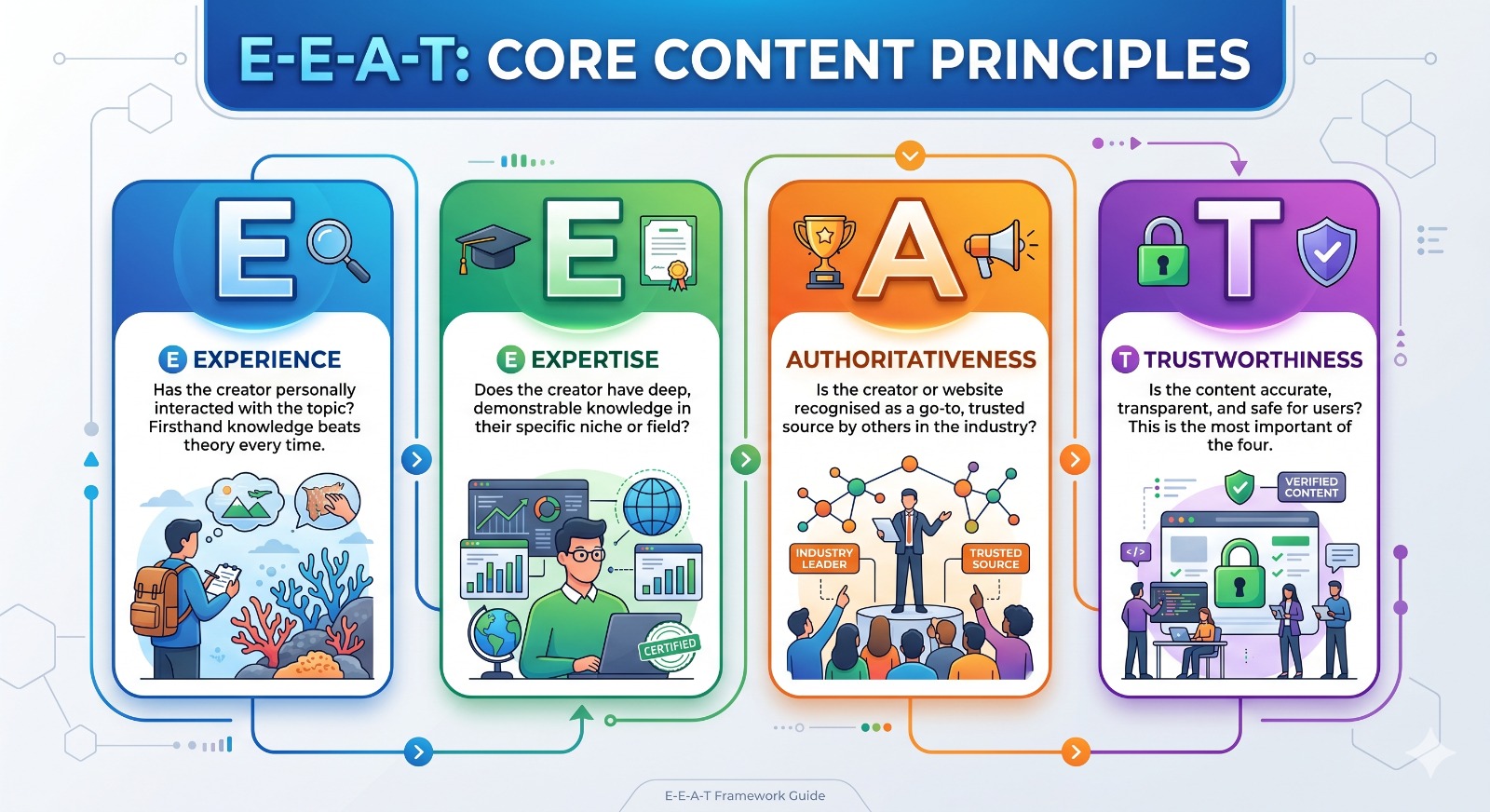
Google is explicit that Trust sits at the centre of these four elements. As their guidelines state: “Trust is the most important member of the E-E-A-T family because untrustworthy pages have low E-E-A-T no matter how Experienced, Expert, or Authoritative they may seem.” That sentence alone tells you a lot about where to focus your energy.
A brief history of how we got here
- Aug 2018: Google’s “Medic Update” shook the health and wellness sector, making E-A-T a household term for SEO professionals. Websites lacking credibility signals lost significant rankings overnight.
- Dec 2022 : Google added the first “E” for Experience to create E-E-A-T, recognizing that firsthand knowledge adds a layer of credibility no amount of research can fully replicate.
- Feb 2023: The Product Reviews Update rewarded content from people with genuine hands-on experience, directly punishing thin reviews written without real product contact.
- Aug 2023: The August Core Update reinforced E-E-A-T signals across all content categories, not just YMYL topics.
- Sep 2023: The Helpful Content Update pushed people-first content to the forefront, explicitly targeting content written for search engines rather than human readers.
- Mar 2024: Google’s Core Update resulted in mass deindexing of low-quality, largely AI-generated sites — a clear signal that E-E-A-T enforcement was intensifying.
Is E-E-A-T actually a ranking factor?
This is the question that generates more debate in SEO communities than almost any other. The honest answer is: not directly, but practically it absolutely matters.
Google has never listed E-E-A-T as a confirmed algorithmic ranking signal in the way that backlinks or page speed are. What it is, is a set of guidelines that human Quality Raters use to assess search results. Their assessments then feed back into how Google refines its algorithm over time. So E-E-A-T does not flip a switch in the ranking system, but it shapes the direction of the very algorithm that does the ranking.
Think of it this way. Google’s stated goal is to surface the most helpful, credible content for any search query. E-E-A-T defines what “credible and helpful” looks like. If you consistently produce content that meets those criteria, you are aligning with what Google is trying to reward, and your rankings reflect that over time.
The practical reality: Websites that demonstrate strong E-E-A-T consistently earn better backlinks, longer time-on-page, lower bounce rates, and more return visits. All of those are measurable signals that do directly influence rankings. So even if E-E-A-T is not a ranking factor in the strict technical sense, its downstream effects most certainly are.
YMYL: why some industries feel E-E-A-T pressure more than others
E-E-A-T matters across all content categories, but Google applies it most rigorously to what it calls YMYL topics: Your Money or Your Life. These are topics where inaccurate or misleading information could have serious real-world consequences for the people reading it.
YMYL categories include medical and health information, financial and legal advice, safety guidance, government and civic information, and e-commerce transactions involving sensitive products. If your website operates in any of these spaces, the bar for demonstrating E-E-A-T is significantly higher than for a lifestyle blog or a hobby website.
John Mueller, Google’s Search Advocate, has been direct about this: content in high-stakes categories needs to come from people who genuinely understand what they are doing. A run-of-the-mill website with no clear expertise or accountability simply will not cut it for YMYL queries, regardless of how well it is technically optimised.
Breaking down each element with practical examples
Experience: have you actually done this?
Experience is the newest addition and in many ways the most interesting. Google’s Quality Rater Guidelines specifically ask reviewers to consider whether the content creator has the necessary firsthand or life experience for the topic.
A product review carries far more weight when the reviewer has actually used the product. A travel guide means more when the writer has walked those streets themselves.
For businesses and content creators, demonstrating experience looks like including original photographs rather than stock images, sharing specific details that only come from direct involvement, writing case studies grounded in real client work, and including personal anecdotes that add texture to the information. These are signals that a human being with genuine knowledge produced the content, not someone regurgitating information they found elsewhere.
Expertise: depth over breadth
Expertise is about how deep your knowledge goes, not how wide. Google does not expect every website to be staffed by professors and credentialed professionals, but it does expect content on any given topic to reflect genuine mastery of that subject area. A quilting blogger who has spent a decade perfecting her craft demonstrates expertise through the depth and precision of her tutorials, not through academic credentials.
Authoritativeness: what others say about you
Authority is largely external. It is not what you say about yourself but what others say about you. The primary signal Google uses to assess authoritativeness is your backlink profile: which websites link to you, how reputable those sites are, and whether the links come from sources that are genuinely relevant to your topic area.
Beyond backlinks, authoritativeness is built through press mentions, citations in industry publications, guest contributions to respected platforms, and recognition from peers and experts in your field. This is why digital PR has become such a meaningful part of modern SEO strategy. Getting your brand mentioned in the right places does not just drive referral traffic. It signals to Google that your website is considered a reliable source by the wider web.
Trustworthiness
Trust encompasses everything that tells a user and a search engine that your website is safe, honest, and reliable. It starts with the technical basics: HTTPS encryption, a functioning SSL certificate, clear privacy policies, and accessible contact information. But it extends well beyond that.
Transparent authorship, fact-checked content, ethical advertising disclosure, prompt correction of errors, and genuine customer reviews all contribute to trustworthiness in Google’s eyes. A website that makes it difficult to verify who is behind the content, that buries contact information, or that presents affiliate content without disclosure is signaling low trust regardless of how good the writing is.
How to actually improve your E-E-A-T
Understanding the theory is one thing. Here is what actually moves the needle in practice:
- Add detailed author bios to every piece of content. Include credentials, relevant experience, and links to professional profiles. A named author with a verifiable background adds an immediate trust signal that anonymous content simply cannot match.
- Create original research, case studies, and data. Content that presents findings no one else has published is inherently authoritative. It earns natural backlinks, gets cited, and demonstrates genuine depth of knowledge.
- Link to credible external sources. When you cite statistics or make specific claims, link to the primary source. This shows readers and Google that you have done your research and are not asking anyone to take your word for it.
- Earn quality backlinks strategically. Guest posting on respected industry sites, building relationships with journalists, and creating genuinely link-worthy content are the sustainable routes to authority. Buying links or engaging in link schemes does the opposite of what you want.
- Update existing content regularly. Outdated information is a trust killer. A guide that was accurate two years ago but has not been touched since tells Google and users that the site is not actively maintained. Regular content audits keep your pages fresh and your credibility intact.
- Make your website technically trustworthy. HTTPS, fast loading speeds, mobile responsiveness, accessible contact details, and a clear About page are not optional for a website that wants to demonstrate trust. They are baseline requirements.
- Display genuine customer reviews and testimonials. User-generated content that reflects real experiences adds the social proof dimension of trust that branded content alone cannot provide.
Quick win: Start with your existing top-performing pages. Add a named author bio, check that all external citations link to live, credible sources, and verify the information is still accurate and up to date. These three changes alone can meaningfully improve the E-E-A-T signals on pages that are already getting traffic.
E-E-A-T and AI-generated content
This is the question that every content team is wrestling with right now, and it deserves a direct answer. Google has not banned AI-generated content. What it has done is make clear that it will demote content that lacks originality, depth, factual accuracy, and genuine usefulness — and a great deal of mass-produced AI content fails on all four counts.
The March 2024 Core Update demonstrated this with unusual clarity. Hundreds of websites, many of which had scaled content production using AI without meaningful human oversight, lost their rankings or were deindexed entirely. The pattern was consistent: AI content that added no unique perspective, cited no original sources, and reflected no firsthand experience was treated as low quality regardless of how grammatically polished it appeared.
The practical guidance is straightforward. AI can be a useful tool for research, outlining, and drafting, but every piece of content that goes live should reflect genuine human expertise, be reviewed by someone with real knowledge of the subject, and add something to the conversation that does not already exist in identical form elsewhere. That is the standard E-E-A-T demands, and it is the standard that will protect your rankings regardless of how Google’s approach to AI evolves. If you want to understand how AI is reshaping the broader search landscape, our piece on AI visibility and SEO covers that shift in detail.
E-E-A-T across your whole digital presence
One thing that most E-E-A-T guides miss is that trust and authority are not built on your website alone. Google forms a picture of your brand’s credibility from signals across the entire web, and your presence on social platforms, in industry communities, and across earned media all feed into that picture.
Your social media presence matters because it demonstrates that a real, engaged brand is behind the content. If someone lands on your website and then checks your social profiles to verify who you are, what they find there either reinforces or undermines the trust signals on your site. Understanding how platform algorithms work, including our guide on how the Instagram algorithm works in 2026, helps you build a consistent, credible presence across channels that supports your overall authority.
Social media also contributes to E-E-A-T indirectly by generating the kind of brand recognition and engagement that leads to branded searches, which are themselves a positive signal of authority. Our guide on how social media indirectly helps SEO explains the mechanisms behind this relationship in detail.
E-E-A-T and topical authority: two sides of the same coin
E-E-A-T and topical authority are closely related concepts that work together rather than in isolation. Topical authority is about demonstrating to Google that your website comprehensively covers a specific subject area, rather than publishing scattered content across unrelated topics. E-E-A-T is about demonstrating that the content you publish on those topics is credible, experienced, and trustworthy.
A website that publishes deeply expert content consistently within a defined niche builds both simultaneously. Google comes to recognize the site as a reliable, authoritative destination for that topic, and the E-E-A-T signals on individual pages are reinforced by the overall pattern of expertise the site demonstrates. Our detailed guide on what is topical authority in SEO is worth reading alongside this one for a complete picture of how these two frameworks interact.
At Enovatorz, we work with businesses across the US and UK to build sustainable SEO strategies grounded in both topical authority and E-E-A-T principles, helping brands earn the trust of Google and their audiences simultaneously rather than chasing short-term ranking gains that do not hold.
A side-by-side look at high and low E-E-A-T
| Signal | High E-E-A-T | Low E-E-A-T |
|---|---|---|
| Authorship | Named author with verified credentials and bio | Anonymous, “Admin,” or no author listed |
| Content depth | Comprehensive, specific, original insights | Thin, surface-level, easily replicated |
| Sources | Cited, linked to credible primary sources | No citations, vague claims, outdated references |
| Backlinks | Links from relevant, reputable industry sites | Low-quality links or no backlink profile |
| Website trust | HTTPS, privacy policy, clear contact info | HTTP, no contact page, no About section |
| Content freshness | Regularly reviewed and updated | Published once, never revisited |
| Reviews and UGC | Genuine customer reviews prominently displayed | No reviews or fake/incentivized testimonials |
The bottom line
E-E-A-T is not a checklist you complete once and forget. It is an ongoing commitment to producing content that is genuinely useful, created by people who know what they are talking about, and presented in a way that users and search engines can trust. That sounds straightforward because it is. The difficulty is consistency.
Google’s direction of travel is clear and has been consistent for years. It is moving toward rewarding content that demonstrates real human expertise, genuine firsthand experience, and verifiable credibility. Websites that invest in building those qualities now are positioning themselves well not just for current rankings but for whatever algorithmic changes come next. Those that cut corners with low-quality content, vague authorship, and no meaningful trust signals will find the environment increasingly difficult.
If you want to understand how E-E-A-T connects to broader content strategy and community building, our guide on loyalty building through social platforms offers useful perspective on how trust translates across digital channels.
How does Google rank your website?
Google uses hundreds of signals to determine rankings, including backlinks, content relevance and depth, page experience metrics, technical SEO factors, and the quality signals informed by its E-E-A-T guidelines. Human Quality Raters assess search results against these guidelines and their feedback helps Google refine its algorithm. No single factor determines rankings in isolation. It is the combination of strong technical foundations, genuinely helpful content, and credible authority signals that produces sustainable ranking performance.
Is E-E-A-T a ranking factor?
Not in the strict technical sense. Google has not confirmed E-E-A-T as a direct input into its ranking algorithm the way confirmed signals like backlinks are. However, the qualities E-E-A-T describes, credibility, depth, trustworthiness, real-world experience, are exactly what Google's algorithm is designed to identify and reward. Optimising for E-E-A-T improves the signals that do directly influence rankings, making the distinction largely academic for practical SEO purposes.
Is E-E-A-T still relevant in 2025 and beyond?
More relevant than ever. The rise of AI-generated content has flooded the web with material that often lacks genuine experience, depth, or factual reliability. Google has responded by doubling down on the qualities E-E-A-T describes, making it increasingly difficult for low-quality content to maintain visibility regardless of how technically optimised it is. For businesses and content creators who invest in genuine expertise and credibility, E-E-A-T is not a challenge but an opportunity to differentiate from the noise.
