farah

What is Amazon FBA and Is It Still Worth It in 2026?

When Daniel from Chicago launched his first Amazon product in 2021, he spent his evenings packing orders in his garage, making daily post office runs, and manually managing returns while holding down a full-time job. Three months later, burnt out and barely breaking even, he switched to Amazon FBA. Within six months, his business had tripled. “I went from dreading every sale to genuinely enjoying the business,” he recalls. “FBA gave me my time back and let me focus on actually growing.” Five years later, that story still resonates with thousands of new and established sellers. But in 2026, with rising fees, intensifying competition, and a dramatically different search landscape than the one Daniel navigated, the question deserves an honest, updated answer. What is Amazon FBA exactly, is it still worth it, and what do sellers need to know before committing to the model this year? What Amazon FBA Actually Means FBA stands for Fulfillment by Amazon. In practical terms, it means you send your inventory to Amazon’s fulfilment centres and Amazon takes over from there. When a customer places an order, Amazon picks the product from its warehouse, packs it, ships it, handles tracking, manages customer service related to delivery, and processes any returns. As a seller, your role shifts from logistics operator to business builder. Instead of coordinating warehousing, packing materials, courier accounts, and returns processing, you focus on product selection, listing optimisation, advertising, and brand development. Amazon becomes your operational backbone whilst you concentrate on growth. This isn’t just a convenience arrangement. FBA products automatically qualify for Prime delivery, which means the Prime badge appears on your listing. Given that Amazon’s Prime membership base exceeds two hundred million people globally and that Prime members spend significantly more annually than non-Prime customers, that badge carries genuine commercial weight on every listing it appears on. How FBA Works Step by Step The process itself is relatively straightforward once you understand the flow. You source your products, whether from a manufacturer, wholesaler, or your own production process, and ship them in bulk to one of Amazon’s designated fulfilment centres rather than to your own address or storage. Once your inventory arrives and is processed, Amazon stores it in their system under your seller account. Your listings then automatically reflect the available stock levels. When a customer orders, Amazon’s fulfilment operation takes over completely. Orders placed before certain cutoff times go out the same day, which is part of why Prime delivery promises are so consistently met. Returns flow back to Amazon’s processing centres. Depending on the condition of returned items, Amazon may restock them, classify them as customer-damaged, or return them to you at your request. Understanding this returns flow matters because returned inventory that isn’t resaleable still incurs some fees, which is worth accounting for in margin calculations. The Real Costs of FBA in 2026 This is where honest assessment becomes essential, because the financial picture of FBA has shifted meaningfully in the past two years. Amazon has implemented multiple fee structure changes, and 2026 sellers are operating under a cost environment that looks quite different from 2021 or even 2023. Table: FBA Fee Categories Every Seller Needs to Understand Fee Type What It Covers Key Consideration Fulfilment Fee Picking, packing, shipping per unit Based on size and weight, rises with product dimensions Storage Fee Monthly inventory holding cost Increases significantly for slow-moving stock after ninety days Aged Inventory Surcharge Extra charge for stock over three hundred and sixty-five days Penalises overstocking heavily Returns Processing Fee Handling customer returns in certain categories Applies per return in relevant product types Referral Fee Amazon’s percentage of every sale Typically eight to fifteen percent depending on category Inbound Placement Fee Getting stock distributed across fulfilment network Relatively new addition that caught many sellers off guard The honest reality is that FBA fee increases have compressed margins for sellers who haven’t actively managed their cost structures in response. Products that were comfortably profitable two years ago may now require repricing, reduced advertising spend, or sourcing renegotiations to maintain acceptable margins. Sellers who understand their unit economics precisely are navigating this environment well. Those relying on rough estimates are struggling. This connects directly to something that separates successful Amazon businesses from struggling ones: the discipline to know your exact cost per unit sold before scaling rather than after. Amazon’s own reporting tools in Seller Central have improved significantly and provide detailed FBA fee breakdowns per ASIN, which makes this calculation more accessible than it used to be. What Has Changed in 2026 That Sellers Must Understand The Amazon marketplace in 2026 is genuinely different from the platform that produced easy wins for early FBA adopters. Several shifts are reshaping what effective selling looks like. Amazon’s AI search has transformed product discovery. Amazon Rufus, the platform’s AI shopping assistant launched in late 2024 and now fully integrated into the search experience, fundamentally changes how customers find products. Rather than typing short keywords into the search bar, buyers increasingly ask conversational questions. “What’s a good protein powder for someone who works out in the evenings” surfaces results through a different mechanism than “protein powder vanilla.” Listings optimised only for traditional keywords miss this conversational layer entirely. This evolution on Amazon mirrors a broader shift happening across every search environment. Understanding what Answer Engine Optimization means and how it differs from traditional SEO gives important context for why Amazon listing strategy must now account for how AI systems interpret product information, not just how keyword-matching algorithms rank it. Brand building has become non-negotiable. The era of unbranded generic products succeeding purely on price has largely ended. Amazon’s algorithm, as we explored in detail in our guide on how Amazon’s search algorithm decides which products rank first, now rewards brand signals, review quality, and conversion performance in ways that disadvantage commodity listings without distinctive positioning. Brand Registry, which gives sellers access to A Plus Content, Stores, Brand Analytics, and enhanced protection against listing hijackers, has shifted from

What is Amazon FBA and Is It Still Worth It in 2026? Read More »
What is Programmatic SEO and Why Google’s March 2026 Update Changed the Rules

For the past few years, a quiet strategy has powered some of the biggest organic traffic numbers on the internet. Property sites listing every postcode in the country. Comparison platforms covering thousands of product combinations. Travel sites with a page for every city pair imaginable. None of these were written one article at a time by a content team. They were generated by systems built specifically for scale. That strategy is called programmatic SEO, and it has just been through the most significant stress test of its existence. Google’s March 2026 core update explicitly targeted what the company calls scaled content abuse, and sites running thin, templated pages without genuine value saw ranking losses of 60 to 90% almost overnight. Sites running programmatic SEO properly, built on real data and genuine differentiation, came through largely unaffected, and in many cases stronger than before. Understanding the difference between those two outcomes is now essential for any business considering this approach in 2026. What Programmatic SEO Actually Is Programmatic SEO is the practice of generating large numbers of web pages automatically using structured data and reusable templates, rather than writing each page manually one at a time. Instead of a content team producing ten blog posts a month, a programmatic system might produce ten thousand pages built from a database, an API, or a structured spreadsheet, each targeting a specific, narrow search query. You have almost certainly used websites built this way without realising it. Property platforms with a dedicated page for every postcode and property type. Software comparison sites with a page for every tool paired against every competitor. Travel booking sites with a page for every route between two cities. Each of these pages exists because someone built a system capable of generating it from underlying data, not because someone manually wrote it. The logic behind programmatic SEO is straightforward. Search demand has become extremely fragmented. People rarely type broad, generic queries anymore. They search for very specific combinations of needs, locations, products, or problems, the kind of long-tail query that would take a content team years to cover manually but that a well-built data system can address in days. Why Google’s March 2026 Update Changed Everything Before March 2026, programmatic SEO occupied something of a grey area. Done with genuine data differentiation, it produced real, sustainable organic growth. Done with thin variable substitution, swapping a city name or product name into an otherwise identical template, it produced inflated traffic numbers that worked until Google caught up. Google’s March 2026 core update closed that grey area decisively. The company’s Search Relations team explicitly named three patterns as violations of its scaled content abuse policy: mass AI page generation without editorial review, pure template-with-variable substitution at scale, and aggregator pages that add no additional context beyond the source data they pull from elsewhere. Sites built on these patterns saw the full impact of the update within roughly two weeks of rollout, with no warning issued through Search Console beforehand. The mechanism behind the update is what makes it particularly important to understand. Before March 2026, a site with tens of thousands of programmatic pages could benefit from the aggregate crawl activity and internal linking density of having so many pages live, even if a meaningful portion of those pages were genuinely thin. After the update, the quality signal from the weakest pages drags down the entire domain’s authority rather than being isolated to those specific pages. This is sometimes described as a weakest-link effect, and it means a site can no longer hide thin content behind a larger volume of stronger pages. Factor Before March 2026 After March 2026 Thin page tolerance Diluted by overall site volume Drags down domain-wide authority Variable substitution alone Often sufficient to rank Explicitly classified as a policy violation Aggregator pages with no added context Could rank on data volume alone Targeted directly by the update Pages with genuine data differentiation Performed well Continue to perform well or better Detection method Manual actions, gradual decline Algorithmic, automatic, rapid Recovery timeline for legitimate sites caught in shifts N/A Many self-corrected within 60 days The critical distinction Google drew is between programmatic SEO as a discipline and scaled content abuse as a tactic. Sites with real data differentiation per page, verified local business listings, live pricing data, genuine inventory information, were not the intended target, even though some experienced temporary collateral ranking shifts during the rollout. How Legitimate Programmatic SEO Actually Works in 2026 The businesses still seeing strong results from programmatic SEO after the update share a consistent set of practices that separate genuine systems from disguised mass production. It starts with a search pattern, not a single keyword. Rather than targeting one competitive term, programmatic SEO identifies a pattern across thousands of related searches. A single well-designed template addressing “best [product type] for [use case] in [location]” can unlock thousands of distinct search terms that would be commercially impossible to address through individually written content. Templates provide structure, not the content itself. A template defines how information is organised and presented consistently, but the actual content populating each page needs to come from genuinely differentiated data. This is the single most important distinction between programmatic SEO that survives algorithm updates and scaled content abuse that gets penalised. Real data is the foundation, not an afterthought. Common data sources include product catalogues, location and demographic data, pricing information that updates in real time, user reviews, and proprietary benchmarks a business has collected itself. Pages built around this kind of concrete, verifiable information naturally provide more value than pages that simply repeat generic explanations with a different city name inserted. Uniqueness needs to be measurable, not assumed. A practical standard many agencies now apply is ensuring a meaningful percentage of fields on each page, often 50% or more, differ substantively from page to page. If two pages in a template only differ by a postcode whilst every other sentence is identical, that page set is exactly the

What is Programmatic SEO and Why Google’s March 2026 Update Changed the Rules Read More »

What is conversational

What is Conversational Commerce and Why Your Website Needs an AI Chat Assistant in 2026

Picture two versions of the same online shopper. In the first, she lands on a product page, scrolls through a wall of specifications, opens three tabs to compare sizes, abandons her cart when she can’t quickly find shipping information, and never returns. In the second, she lands on the same product page, types “does this work for sensitive skin and how long does UK delivery take” into a chat box, gets an instant accurate answer, asks a follow-up question about a discount code, and completes her purchase in under two minutes. The product was identical. The price was identical. The only difference was whether the website could hold a conversation. That difference is now worth measuring in actual revenue. Conversational commerce, once dismissed as a novelty chatbot trend, has become one of the most commercially significant shifts in how people shop online. For businesses still relying purely on static menus, filters, and FAQ pages, the gap between them and competitors offering conversational experiences is widening every quarter. What Conversational Commerce Actually Means Conversational commerce is the use of AI-powered chat, messaging apps, and voice assistants to guide customers through the shopping journey, from product discovery through to completed purchase, inside an ongoing conversation rather than a traditional click-through funnel. Unlike conventional e-commerce, where a customer navigates menus, applies filters, and works through a checkout funnel largely alone, conversational commerce works like having a knowledgeable shop assistant available 24 hours a day. The assistant understands what the customer actually wants rather than just what they typed, recommends the right product based on their specific situation, answers detailed questions about features and compatibility in real time, and guides them smoothly toward checkout. The channels involved span website chat widgets, WhatsApp, Facebook Messenger, SMS, voice assistants like Alexa and Google Assistant, and increasingly autonomous AI agents that can complete purchases entirely within a conversation. Market research from Mordor Intelligence values the global conversational commerce market at $12.64 billion in 2026, with projections showing continued rapid growth through the rest of the decade. Why This Matters So Much Right Now The shift toward conversational commerce isn’t happening because it sounds futuristic. It’s happening because the conversion data has become impossible to ignore. Research compiled across multiple platforms shows AI chat users converting at 12.3% compared to 3.1% for visitors who don’t engage with chat, a roughly fourfold improvement. Chatbot-powered websites see conversion rate increases of around 23% compared to sites without conversational features. Shoppers who engage with an AI assistant are 40% more likely to click through to a product and 25% more likely to complete a purchase. These aren’t isolated case studies from small pilot programmes. A major homewares brand documented in McKinsey’s 2025 research on AI personalisation saw their gen-AI shopping assistant double conversions compared to standard search and achieved a 5x conversion rate over sessions without assistance. During Black Friday weekend, one retail group recorded a 35.2% higher conversion rate using an AI commerce assistant compared to their baseline performance. The explanation behind these numbers connects directly to something we explored in our guide to building a multi-channel digital marketing strategy. Customers move through discovery, consideration, and conversion stages, and friction at any point causes drop-off. Conversational commerce removes friction at precisely the moment it matters most, when a customer has a specific question standing between them and a purchase decision. Metric Without AI Chat With AI Chat Improvement Average conversion rate 3.1% 12.3% Approximately 4x Click-through likelihood Baseline +40% Significant lift Purchase completion likelihood Baseline +25% Significant lift Decision-making speed Baseline 47% faster Nearly half the time Bounce rate reduction Baseline Up to 30% lower Meaningful retention gain Average order value Baseline +9 to 20% Higher basket value The Three Layers of Modern Conversational Commerce Understanding conversational commerce properly means recognising it operates across three distinct but connected layers, each serving a different purpose in the customer journey. Discovery and recommendation is the entry point where AI assistants help customers find the right product when they don’t know exactly what they’re looking for. Rather than forcing customers through rigid filter menus, a well-built assistant asks clarifying questions the way a good in-store employee would. What’s the occasion? What’s your budget? Have you tried something similar before? This natural back-and-forth surfaces relevant products faster than manual browsing ever could, and it builds the kind of demonstrated helpfulness that strengthens E-E-A-T signals customers associate with trustworthy brands. Real-time question answering addresses the specific objections and uncertainties that cause cart abandonment. A customer unsure whether a product suits their needs, confused about sizing, or wanting to know exact delivery timeframes will often simply leave rather than search through help pages or wait for an email reply. Instant, accurate answers delivered in conversation keep that customer moving toward checkout instead of toward a competitor’s tab. Transactional completion, sometimes called agentic commerce, represents the most advanced layer where the conversation itself becomes the checkout. OpenAI’s partnerships with major retail and delivery platforms in 2026 signal that purchasing entirely within a chat interface, without ever visiting a traditional product page, is moving from experimental to mainstream. Bloomreach’s enterprise implementation data shows customers using this layer generating a 9% conversion lift and 20% higher average order value compared to standard browsing. How Conversational Commerce Connects to Your Broader Digital Strategy Conversational commerce doesn’t operate in isolation from everything else a business does online. It works best, and delivers its strongest results, when it’s built on the same foundations that strengthen every other part of digital performance. The product information, policies, and specifications that power an effective chat assistant are the same structured content that supports schema markup implementation across your website. When your product data is clean, consistent, and properly structured, both your AI chat assistant and search engines understand your offerings more accurately, creating a compounding benefit from a single data investment. There’s also a direct line between conversational commerce and zero-party data collection. Every conversation a customer has with your AI assistant generates explicit,

What is Conversational Commerce and Why Your Website Needs an AI Chat Assistant in 2026 Read More »

what is zero party data

What is Zero-Party Data and Why Smart Marketers Are Collecting It in 2026

For years, digital marketing ran on a simple but increasingly shaky foundation. Businesses collected data about their customers through tracking pixels, third-party cookies, and behavioural inference. They knew which websites their customers visited, what they searched for, and what they bought from competitors. Then they used that data to target advertising, personalise experiences, and predict future behaviour. That foundation is now crumbling. Apple’s privacy updates removed cross-app tracking for millions of iOS users. Google has spent years signalling the end of third-party cookies. GDPR in the UK and Europe, along with CCPA in the United States, gave consumers legal rights over how their data is collected and used. The result is a landscape where the data many businesses built their entire marketing strategy around is either disappearing or becoming legally risky to collect. Here’s the thing though. The marketers who prepared for this shift aren’t panicking. They’ve spent the past two years building something far more valuable than inferred behavioural data. They’ve been collecting zero-party data. And in 2026, that preparation is paying off significantly. What Zero-Party Data Actually Means Zero-party data is information that a customer intentionally and proactively shares with a brand. Not data you inferred from their browsing behaviour. Not data purchased from a third-party broker. Not data collected through tracking technologies that users increasingly block. Data they chose to give you directly, often in exchange for a personalised experience, a recommendation, or some other form of genuine value. The term was coined by Forrester Research to distinguish this category from first-party data, which is behavioural data you collect from interactions on your own platforms, and third-party data, which is purchased from external sources. Table 1: Understanding the Four Types of Marketing Data in 2026 Data Type Source Example Privacy Risk Future Reliability Zero-Party Customer shares deliberately Quiz answers, preferences, survey responses Very Low Very High First-Party Your own platform interactions Website visits, email opens, purchase history Low High Second-Party Partner data sharing Co-marketing audience data from trusted partner Medium Medium Third-Party External data brokers Purchased audience segments, tracking cookies Very High Very Low The critical word in the zero-party definition is intentional. When someone fills out a product recommendation quiz on your website, they’re not passively being tracked. They’re actively choosing to tell you something about themselves because they believe you’ll use it to serve them better. That consent transforms the nature of the data entirely, both ethically and practically. A customer who tells you they prefer plant-based products, have a budget of around £50, and are shopping for a gift is giving you something infinitely more useful than inferred preferences cobbled together from browsing patterns across dozens of sites. They’re telling you exactly what they want. Why 2026 Has Made Zero-Party Data Essential The shift toward zero-party data isn’t a theoretical future consideration. It’s a present-day business requirement driven by three converging forces that are reshaping how marketing works across both the US and UK markets. Privacy regulations have fundamentally changed the rules. The UK GDPR, which retained the core requirements of EU GDPR post-Brexit, requires explicit consent for most forms of personal data collection. The Information Commissioner’s Office (ICO) has significantly increased enforcement activity, with fines reaching into the tens of millions for violations. Marketing built on implicit data collection without clear consent carries genuine legal risk that the business world has been slow to fully acknowledge. Technical tracking has become unreliable. iOS privacy updates allow users to block cross-app tracking with a single tap, and the majority choose to do so. Browser-level tracking prevention in Safari, Firefox, and increasingly Chrome reduces cookie-based tracking accuracy. Ad blockers are used by roughly 40% of UK internet users. The technical infrastructure that third-party data relied on is fragmenting faster than many businesses anticipated. AI-powered personalisation demands better data quality. As we covered when discussing marketing automation implementation, AI tools deliver transformational results when they have clean, accurate data to work with and produce poor results when they don’t. Zero-party data, being deliberately provided and inherently accurate, is the highest quality input you can feed into personalisation systems.                                                                                                                                                                           How Zero-Party Data Collection Actually Works The mechanics of collecting zero-party data depend on creating exchanges where customers genuinely want to participate because the benefit to them is clear and immediate. Preference centres give customers direct control over their experience. Rather than inferring what someone wants to receive from you, you ask them. What topics interest them? What email frequency suits them? What products are they shopping for? This approach reduces unsubscribes and improves engagement simultaneously because customers receive content they’ve actively indicated they want. Interactive quizzes and assessments are one of the highest-converting zero-party data collection methods. A skincare brand asking customers about their skin type, concerns, and budget before recommending products collects enormously valuable preference data whilst providing a genuinely useful service. A financial services company asking about life stage, goals, and risk appetite before suggesting relevant content does the same. The quiz itself is the value exchange. Post-purchase surveys capture intent and satisfaction data at the moment customers are most engaged. Asking what a customer plans to do with their purchase, whether they bought it as a gift, and what influenced their decision gives you context that purchase history alone cannot provide. Product registration forms that go beyond basic warranty information to capture usage scenarios, goals, and preferences build detailed customer profiles from willing participants at a natural touchpoint. Wishlist and save features reveal genuine purchase intent without requiring any inference.

What is Zero-Party Data and Why Smart Marketers Are Collecting It in 2026 Read More »

What is Search Everywhere Optimization and Why Google Alone is No Longer Enough in 2026

Not long ago, a solid Google SEO strategy was enough. Rank well on the first page, drive organic traffic, convert visitors into customers. The formula was straightforward, and for most of the past two decades it worked reliably. That formula is breaking down fast. In 2026, 58.5% of US searches end without a single click to any website. Google’s own AI Overviews answer millions of queries before users even consider visiting a page. Nearly half of consumers under 40 now use TikTok as a search engine. Gen Z users prefer YouTube for how-to queries. Shoppers start product research on Amazon before ever typing into Google. Professionals validate decisions on LinkedIn and Reddit. Your customers are searching everywhere. If you’re only optimising for Google, you’re invisible in the places where an enormous and growing share of your market actually looks for what you offer. This is exactly why Search Everywhere Optimization has become the most important strategic shift in digital marketing in 2026. What Search Everywhere Optimization Actually Means Search Everywhere Optimization, sometimes abbreviated as SEvO, is the practice of making your brand discoverable across every platform where your target audience actively searches, not just traditional search engines. It starts from a simple but profound observation: search behaviour has fragmented. People no longer have one go-to discovery method. A 25-year-old looking for a skincare product might search Instagram for visual recommendations, check TikTok for honest reviews from real people, then visit Amazon to compare prices and read detailed reviews, and only then perhaps conduct a Google search. A B2B buyer evaluating software might start with a Reddit thread, ask ChatGPT for a vendor comparison, read LinkedIn posts from industry voices, and check the company’s YouTube channel for product walkthroughs. At no point in either of those journeys does a traditional search result necessarily appear. If a business is only optimising for Google, it’s absent from most of that discovery process. Search Everywhere Optimization addresses this by building intentional, optimised presence across every platform where your specific audience searches. The key word is intentional. This isn’t about being everywhere indiscriminately. It’s about identifying where your customers genuinely search and building optimised content for each of those surfaces. Why This Shift Has Happened So Quickly Three converging forces have fragmented search behaviour faster in the past two years than in the previous decade combined. AI has changed Google itself. Google’s AI Overviews now answer millions of queries directly on the results page, meaning ranking highly no longer guarantees a click. Understanding what Answer Engine Optimization means and how it differs from traditional SEO is essential context here, because being cited in an AI-generated answer is now as valuable as ranking on page one, sometimes more so. Social platforms have built powerful search functions. According to Adobe’s 2026 Digital Trends Research, nearly half of all consumers use TikTok as a search engine, with 64% of Gen Z preferring it specifically for discovery. Instagram, Pinterest, and YouTube all have search functions that millions of users treat as primary discovery tools. AI assistants have become research partners. ChatGPT, Perplexity, Gemini, and Claude now handle billions of queries monthly. Users ask these tools for vendor recommendations, product comparisons, and expert guidance. How your brand appears in these AI-generated responses, which connects directly to Generative Engine Optimization, determines whether you’re part of the conversation or absent from it entirely. The Platforms That Actually Matter in 2026 Not every platform deserves equal investment. The right mix depends entirely on where your specific customers search. That said, most businesses should be considering these core surfaces. Table 1: Search Everywhere Platform Guide for 2026 Platform Who Searches There Content Format Optimisation Priority Google All demographics, all intents Text, images, video Essential for all businesses TikTok Under 40s, product discovery, how-to, lifestyle Short video High for B2C, growing for B2B YouTube All demographics, tutorials, reviews, education Long and short video High for most industries Amazon Shoppers ready to buy Product pages, A+ content Essential for e-commerce Pinterest Women 25 to 45, visual products, home, fashion, food Images, idea pins High for visual products Reddit Researchers, sceptics, community-driven queries Text discussions Medium for most, high for tech/finance LinkedIn B2B buyers, professionals, service businesses Articles, posts, video High for B2B AI Platforms All demographics, research and comparison queries Cited web content Growing rapidly for all businesses Google: Still Essential But Not Sufficient Google remains the largest search platform and deserves continued investment. Strong topical authority remains the foundation of Google visibility. Building comprehensive, expert content clusters around your core subject area signals authority that Google rewards with rankings. Technical fundamentals still matter too. Schema markup helps Google and other search engines understand your content precisely, improving how you appear in rich results, AI Overviews, and featured snippets. It’s a single technical investment that pays dividends across multiple platforms simultaneously. The key shift is treating Google as one important channel rather than the only channel. Your Google strategy should remain strong whilst you build alongside it. Understanding AI visibility and how brand presence matters in 2026 gives important context for why your Google strategy needs to evolve alongside your Search Everywhere approach. TikTok: The Search Engine Nobody Called a Search Engine TikTok’s transformation from entertainment platform to genuine search engine happened quietly but completely. Users now search TikTok the way they once searched Google, typing queries into the search bar and expecting relevant, trustworthy results. The discovery intent on TikTok differs fundamentally from Google. Someone searching TikTok for a product or service isn’t just looking for information. They’re looking for authentic proof from real people in video format. That’s a different and often higher-converting form of discovery because the content demonstrates experience rather than simply claiming it. This connects directly to E-E-A-T principles, where demonstrated experience now matters as much as stated expertise. A TikTok video showing your product actually working in real conditions demonstrates experience in exactly the way Google’s quality guidelines increasingly reward. Amazon: The Search Engine for Buyers For any business

What is Search Everywhere Optimization and Why Google Alone is No Longer Enough in 2026 Read More »

what is dark social media

What is Dark Social and Why It’s Making Your Marketing Analytics Lie to You

Here’s a scenario that plays out in marketing teams every single week. Your team publishes a piece of content on a Thursday morning. By Friday afternoon, your “direct” traffic has jumped 40%, you’ve received a handful of enquiries from companies you’ve never heard of, and your sales team reports three calls from prospects who all say “someone sent me your link.” You check Google Analytics. Organic search is flat. Paid ads show normal performance. Social media referrals are unremarkable. What Dark Social Actually Is Dark social isn’t anything sinister. The term, coined by technology writer Alexis Madrigal back in 2012, simply describes content sharing that happens in private, untrackable spaces where standard analytics tools cannot follow the trail. When someone copies your blog post URL and pastes it into a WhatsApp group chat, that’s dark social.  When someone emails your pricing page to a colleague, screenshots your Instagram post and sends it via iMessage, or shares your video in a private Discord server, all of it is dark social. The reason analytics tools miss it is technical but straightforward. When someone clicks a link from most private messaging apps, the referral data that would normally tell Google Analytics where that visitor came from gets stripped away entirely. The visitor arrives at your website looking to all your tools like they typed your URL directly into their browser. Hence they land in the “direct” bucket, which most marketers assume means the person already knew about the brand and came back directly. In 2026, research from SparkToro shows that platforms like WhatsApp, Slack, Discord, and Telegram fail to pass referral data close to 100% of the time. Even Facebook Messenger clicks appear as direct traffic approximately 75% of the time. The result is that a massive proportion of real, word-of-mouth driven traffic is systematically miscategorised in every analytics report you’re reading right now. Why Dark Social Has Exploded in 2026 Dark social isn’t new, but its scale in 2026 is unlike anything previous years have seen. Three converging trends have made it the dominant form of content discovery for millions of buyers and consumers. Private messaging has overtaken public social. People increasingly share genuinely interesting content in private group chats and communities rather than on public feeds. WhatsApp alone processes over 100 billion messages daily. Slack is home to hundreds of thousands of professional communities. Discord has evolved far beyond gaming into a major content discovery platform across nearly every industry. AI tools are creating an entirely new layer of dark social. When a buyer asks ChatGPT, Perplexity, or Claude to research a product category and your brand gets mentioned in the response, that influence is completely invisible to your analytics. The buyer may visit your site immediately after, landing as direct traffic with no indication whatsoever that an AI recommendation triggered the visit. This new AI-driven dark social is rapidly becoming one of the most significant untracked discovery channels for businesses with strong topical authority in their niche. Privacy regulations and technical changes are hiding more referral data. GDPR, iOS privacy updates, browser tracking prevention, and encrypted connections all strip referral data for entirely legitimate privacy reasons. The net effect is that even traffic that isn’t truly dark social increasingly appears that way in standard analytics reports. The scale of what’s hidden is genuinely striking. Research from Dreamdata found that the average B2B buyer journey in 2026 spans 272 days across 88 touchpoints, with a significant portion of those touchpoints happening in private channels that standard tools simply cannot track. How Dark Social Is Distorting Your Marketing Decisions If you’ve ever looked at your analytics and concluded that content marketing isn’t working, that social media drives negligible traffic, or that most of your visitors come from people already familiar with your brand, there’s a real chance dark social is the explanation rather than reality. Consider what happens when this misattribution compounds over time. Your analytics show that a particular blog post generates almost no traffic from identifiable sources. You deprioritise that content topic going forward. In reality, that post has been circulating in three relevant Slack communities for months, generating warm leads that arrive looking like direct traffic. Your decision based on incomplete data actively harms your strategy. This connects directly to a challenge that has grown significantly with the rise of AI-powered search. Just as Answer Engine Optimization requires understanding how AI systems discover and cite content, dark social requires understanding that your content’s actual influence extends far beyond what any dashboard currently shows you. Dark Social Source Where It Appears in Analytics Percentage That Passes Referral Data WhatsApp Direct traffic Less than 5% Slack and Teams Direct traffic Less than 5% Facebook Messenger Direct traffic Approximately 25% Discord and Telegram Direct traffic Less than 5% Email forwards Direct traffic 0% SMS sharing Direct traffic 0% AI tool recommendations Direct or organic 0% iMessage and Signal Direct traffic 0% What You Can Actually Do About It Dark social can’t be fully measured with current tools, and that’s worth accepting upfront rather than chasing a false sense of complete attribution. What you can do is build a measurement approach that acknowledges the gap and makes smarter decisions despite it. Treat your direct traffic differently. Stop treating high direct traffic as a sign that people know your brand. Start treating it as potential dark social that deserves investigation. When you see direct traffic spikes following content publication, social posts, or campaigns, those spikes are telling you something valuable even without a precise source label. Design content specifically for private sharing. This is where understanding dark social transforms from a measurement challenge into a genuine marketing opportunity. Content that people want to share privately tends to have different characteristics from content designed to perform on public feeds. It’s specific, surprising, genuinely useful, or reflects something the sharer wants their private network to know about them. Understanding how social signals influence SEO and brand perception becomes more nuanced when you account for the

What is Dark Social and Why It’s Making Your Marketing Analytics Lie to You Read More »

how to build multi channnel digitsal marketing

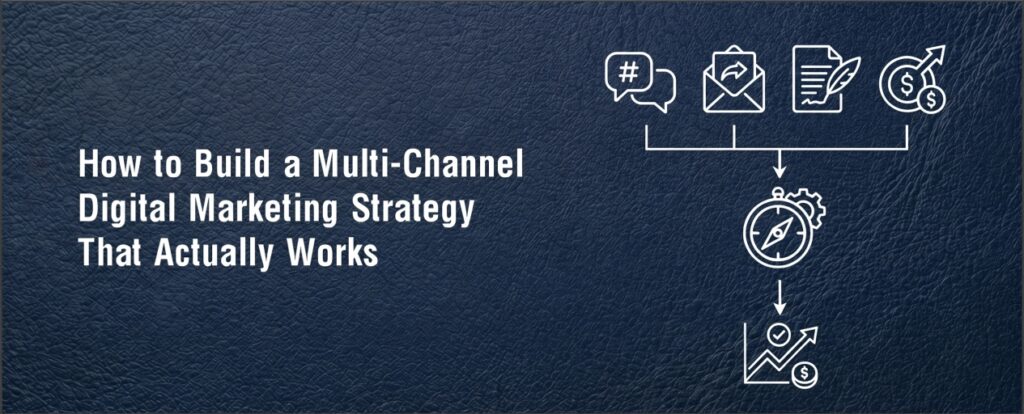
How to Build a Multi-Channel Digital Marketing Strategy That Actually Works

Most businesses understand they should be present on multiple platforms. What far fewer understand is the difference between being present and being strategic. Having a Facebook page, a website, and occasionally posting on Instagram isn’t a multi-channel strategy. It’s scattered activity with no connective tissue. A genuine multi-channel digital marketing strategy means your customer can discover you through Google, see you on Instagram, read your content on LinkedIn, receive a retargeting ad on Facebook, and open a follow-up email — and every single touchpoint reinforces the same message, moves them forward, and feels intentional. According to research from HubSpot’s Marketing Statistics, brands using three or more coordinated channels achieve 287% higher purchase rates than single-channel approaches. Those using five or more see 412% higher purchase rates. The data is compelling. The execution is where most businesses stumble. This guide walks through exactly how to build a multi-channel strategy that drives real results rather than just keeping you busy. Why Single-Channel Thinking No Longer Works Think about your own purchasing behaviour. You probably don’t discover a product, evaluate it, and buy it in a single session on a single platform. You might see a recommendation on social media, then search for reviews on Google, then compare options on a competitor’s site, then finally buy three days later after an email reminds you about a discount. Your customers behave exactly the same way. The modern buyer journey spans multiple devices, multiple platforms, and multiple sessions before a decision is made. Single-channel marketing only captures a fraction of those touchpoints, leaving the rest to competitors who do show up consistently. What makes 2026 different from previous years is the addition of AI-powered discovery to this already complex journey. Customers aren’t just searching on Google anymore. They’re asking ChatGPT, using Perplexity, and getting answers through Google’s AI Overviews. Understanding what Answer Engine Optimization (AEO) is and how it differs from SEO has become essential context for any channel strategy, because visibility now means appearing where AI answers are generated, not just where traditional search results appear. The Foundation: Know Your Customer Journey First Before choosing channels, map out how your specific customers discover, evaluate, and decide. Generic channel advice fails because different businesses have genuinely different customer journeys. A B2B software company might find their customers discover them through LinkedIn content, evaluate through Google searches and case studies, and convert through email nurture sequences. A Shopify fashion brand might get discovery through TikTok and Instagram, evaluation through user-generated content and reviews, and conversion through retargeting ads and abandoned cart emails. The channels you prioritise should match where your customers actually spend time during each stage of their journey, not where you’re most comfortable or where your competitors happen to be. Ask yourself three questions before building your channel mix. Where do my ideal customers first discover solutions like mine? Where do they go to evaluate and compare options? What finally pushes them to make a decision or take action? The answers should drive your channel selection, not industry trends or platform popularity statistics. Building Your Channel Architecture Once you understand the customer journey, you can build a channel architecture that serves each stage deliberately. Think of it in three layers. Discovery Channels create awareness with people who don’t yet know you exist. These typically include organic search through strong SEO and topical authority, social media content, paid advertising, and increasingly, visibility in AI-generated answers through Generative Engine Optimization (GEO). Consideration Channels engage people who are aware of you and evaluating whether you’re the right solution. Email sequences, detailed content marketing, retargeting ads, and case studies all serve this function. Your website’s depth of content matters enormously here, particularly content that demonstrates genuine expertise through strong E-E-A-T signals. Conversion and Retention Channels close the deal and keep customers coming back. Email remains the highest ROI channel at this stage, with every dollar invested returning an average of $36 according to Litmus research. Social media plays a role here too, particularly platforms where post-purchase communities form and brand loyalty develops. Stage Primary Channels Supporting Channels Key Metrics Discovery SEO, paid search, social content, AEO PR, influencer, video Impressions, reach, new visitors Consideration Email, retargeting, content marketing LinkedIn, YouTube, webinars Engagement rate, time on site, return visits Conversion Email, paid social, SMS Live chat, reviews Conversion rate, cost per acquisition Retention Email, social community, loyalty programmes SMS, push notifications Repeat purchase rate, LTV, NPS Content: The Fuel That Powers Every Channel Here’s a truth that separates effective multi-channel marketers from ineffective ones: content isn’t one channel among many. It’s the fuel that powers all of them. Your SEO strategy needs content. Your social media needs content. Your email sequences need content. Your paid ads need compelling creative. Your AI visibility depends on content quality and structure. Without a systematic approach to content creation, every channel runs dry. Understanding what content marketing actually is in 2026 matters more in a multi-channel context than anywhere else because content must work harder across more surfaces simultaneously. A well-written blog post can become an email newsletter, social media posts, short-form video scripts, and the foundation of a paid ad campaign. This repurposing multiplies your return on every piece of content you create. Technical content structure matters too. Implementing schema markup across your website helps search engines and AI systems understand your content accurately, improving how you appear across multiple discovery channels simultaneously. It’s a single technical investment that supports every other channel. Social Media in a Multi-Channel Strategy Social media functions differently in a multi-channel strategy than it does as a standalone tactic. Rather than chasing followers or posting for engagement alone, its role is to serve the broader customer journey at each stage. Discovery-stage social means creating content that reaches people who don’t follow you yet through shares, hashtags, paid promotion, and algorithm distribution. Consideration-stage social means retargeting website visitors, nurturing followers with valuable content, and building the credibility signals that make people trust you enough to buy. Conversion-stage

How to Build a Multi-Channel Digital Marketing Strategy That Actually Works Read More »

Why Marketing Automation Is No Longer Optional: 2026 Implementation Guide

When David’s e-commerce team at a mid-sized London retailer calculated how many hours they spent on repetitive marketing tasks each week, the number shocked him. Twenty-seven hours. Nearly one full-time employee’s entire week devoted to manually scheduling social posts, sending follow-up emails, updating customer segments, and adjusting ad bids based on inventory levels. Within six months of implementing marketing automation, revenue per customer increased 34%, cart abandonment recovery jumped 58%, and the marketing team finally had time to focus on strategy instead of execution. If you are still treating marketing automation as something you will get to eventually, you are not just missing efficiency gains. You are falling behind competitors who have turned automation from optional tool into competitive necessity. Marketing automation does not exist in isolation from the broader digital strategy picture. It works most powerfully when combined with strong search visibility, content infrastructure, and an understanding of how search itself is evolving. Before diving into implementation, it is worth understanding how Answer Engine Optimization and how it differs from SEO in 2026 is reshaping the way businesses attract the traffic that automation then converts. The two disciplines are becoming increasingly interdependent for businesses that want sustainable growth rather than short-term gains. The numbers that make automation non-negotiable Before exploring implementation strategies, understanding the business case helps justify the investment and prioritize resources appropriately. The marketing automation market has reached critical mass. Valued at $47.32 billion in 2026, it is projected to grow to $107.5 billion by 2028. This is not gradual adoption. This is wholesale market transformation driven by measurable business impact. Companies implementing marketing automation properly see an average return of $5.44 for every dollar invested. According to Forrester Research’s marketing automation analysis, businesses using automation report lead generation increases of 450% compared to companies relying only on manual processes, productivity improvements exceeding 12% as teams shift from repetitive execution to strategic planning, customer lifetime value growth of 24% through personalized timely engagement, and sales cycle reductions averaging 23% because automated lead scoring and nurturing moves prospects toward purchase decisions faster than manual handoffs between marketing and sales. Three-quarters of businesses now run some form of marketing automation. The question has shifted from whether to automate to how quickly you can implement effectively. The compounding advantage: Companies that adopted automation early have created substantial advantages. They capture more leads, convert them faster, generate higher customer lifetime values, and operate with lower customer acquisition costs. Each month you delay, they compound their advantage whilst you continue fighting with one hand tied behind your back. What has actually changed to make automation essential now AI has made automation intelligent, not just mechanical Early marketing automation was rule-based. If a customer does X, then send Y. These workflows were effective but rigid, requiring constant manual updates and refinement. Modern automation powered by AI learns, predicts, and adapts. It identifies which customers are most likely to convert and prioritizes them automatically. It tests message variations and optimizes toward the highest-performing content without human intervention. It adjusts timing, channel selection, and creative elements based on individual behavior patterns. Seventy-seven percent of marketers now use AI-powered automation for personalized content creation, while 45% leverage AI specifically for audience targeting. This connects directly to the rise of Generative Engine Optimization, which is changing how AI-driven platforms discover and surface content from businesses. Understanding GEO alongside your automation strategy means you are not just converting existing traffic more efficiently, you are ensuring the AI systems that increasingly drive discovery are finding and recommending your content in the first place. Customer expectations have risen beyond what manual processes can deliver Customers now expect relevant, timely, personalized engagement across every channel. They expect abandoned cart reminders within hours, not days. They expect product recommendations based on browsing history. They expect consistent messaging whether they engage via email, social media, website, or mobile app. Meeting these expectations manually is mathematically impossible once you are operating at any meaningful scale. Content marketing and automation are now inseparable Automation without content is an empty pipeline. Content without automation is an inefficient one. The two have become functionally inseparable for businesses serious about growth in 2026. Understanding what content marketing is and how it works as a complete strategy in 2026 is essential context for building automation workflows that have genuinely useful material to deliver at each stage of the customer journey. Automation determines the when and who. Content determines the what and why. Neither works at full potential without the other. The core capabilities modern marketing automation must include Capability Priority Level Why It Matters Email Automation Essential Foundation of most automation strategies, highest ROI channel Behavioral Triggers Essential Respond to customer actions in real-time across channels Lead Scoring Essential Identify and prioritize highest-value opportunities automatically CRM Integration Essential Unified customer data enables effective automation Multi-Channel Orchestration Essential Customers expect consistent experience across all touchpoints AI-Powered Personalization High Priority Dramatically improves conversion and engagement rates Predictive Analytics High Priority Anticipate customer needs before they express them Customer Segmentation High Priority Deliver relevant messaging to distinct audience groups Email automation: still the foundation Despite newer channels, email automation remains the highest ROI component of most marketing automation stacks. Automated welcome sequences, abandoned cart recovery, post-purchase follow-ups, and re-engagement campaigns deliver measurable revenue with minimal ongoing effort. Modern email automation uses AI to optimize send times for each individual recipient, predict which subject lines will perform best, and personalize content dynamically based on behavior and preferences. Multi-channel orchestration: where advanced teams compete A customer abandons their cart. Your automation system waits one hour, then sends an email. If they do not open within 24 hours, it sends an SMS with a small discount. If they click but do not purchase, it shows them retargeting ads on social media featuring the abandoned items. Each step is automated, coordinated, and optimized based on what historically drives conversion. This level of orchestration is where manual processes completely break down and automation becomes genuinely transformational. Social media plays a critical role in

Why Marketing Automation Is No Longer Optional: 2026 Implementation Guide Read More »

what is answer aeo

What is Answer Engine Optimization (AEO) and How Does It Differ from SEO in 2026?

When Rachel’s marketing team at a London-based SaaS company noticed their organic traffic drop 23% despite maintaining strong Google rankings, she assumed they’d been hit by an algorithm update. The real reason, her consultant explained, was far more fundamental: their competitors weren’t just outranking them anymore. They were being cited directly in AI-generated answers whilst Rachel’s perfectly optimized pages were becoming invisible. “We’d spent years mastering traditional SEO,” Rachel recalls. “Ten blue links, keyword research, backlink acquisition, the whole playbook. Then ChatGPT started recommending our competitors by name whilst our brand never appeared. We were ranking on page one of Google but completely absent from where our customers were actually searching.” If you’ve invested heavily in SEO but noticed qualified traffic declining, or if you’re seeing competitors gain visibility in ways traditional rankings don’t explain, you’re experiencing the most significant shift in search behavior since Google’s launch. Welcome to the era of Answer Engine Optimization. This isn’t about replacing SEO. It’s about understanding that the game has fundamentally changed, and winning now requires strategies that extend far beyond traditional search engine rankings. What is Answer Engine Optimization? Answer Engine Optimization, or AEO, is the practice of structuring your content so AI-powered platforms can easily find, understand, extract, and cite it when generating direct answers to user queries. Where traditional SEO optimizes content to rank in search results pages, AEO optimizes content to become the answer itself—the text that ChatGPT quotes, the source that Perplexity cites, the information that Google’s AI Overviews synthesize, or the recommendation that Claude provides. The distinction is critical. When someone searches “best CRM software for small businesses” on Google in the traditional sense, they receive ten ranked results and choose which pages to visit. When they ask ChatGPT or Perplexity the same question, they receive a synthesized answer that might mention three to five specific products by name, with supporting context explaining why each fits different needs. If your product isn’t cited in that answer, you’re invisible to that user—regardless of whether you rank number one in traditional search results. The Data Behind the AEO Shift Before exploring implementation strategies, understanding the scale and pace of this transition is essential for resource allocation decisions. Zero-click searches now dominate: Approximately 60% of Google searches end without any click to a website. Users get their answer directly from featured snippets, knowledge panels, or AI Overviews, making traditional traffic metrics increasingly incomplete measures of visibility. AI search adoption has reached critical mass: ChatGPT processes over 2 billion queries daily, Google AI Overviews reaches nearly 2 billion users across 200+ countries, and Perplexity handles more than 1.2 billion monthly queries. These aren’t future projections. These are current-day realities. Traditional search volume is declining: Gartner projects that traditional search engine volume will drop 25% by the end of 2026 as users increasingly prefer AI-powered answers over manually scanning search results. AI referral traffic is exploding: Adobe Analytics found that AI-referred traffic to retail websites grew 1,200% between 2023 and 2025, whilst Ahrefs documented a 58% reduction in clicks to the top-ranking page when AI Overviews appear. These numbers reveal more than a trend. They document a structural transformation in how people discover information, evaluate options, and make purchasing decisions. How AEO Fundamentally Differs from Traditional SEO Understanding the mechanical differences between AEO and SEO illuminates why optimization strategies must evolve rather than simply expand. Aspect Traditional SEO Answer Engine Optimization (AEO) Primary Goal Rank higher in search results pages Get cited in AI-generated answers Target System Search engine ranking algorithms AI/LLM retrieval and synthesis systems Content Format Keyword-optimized pages with depth Direct, extractable, conversational answers Success Metrics Rankings, clicks, organic traffic, dwell time AI citations, brand mentions, Share of Answer Query Type Focus Short-tail and mid-tail keywords Long-tail, conversational, question-based queries User Journey User clicks → reads page → takes action AI summarizes → user evaluates → seeks source if needed Optimization Priority Page authority, backlinks, technical SEO Content clarity, entity recognition, structured data Measurement Google Search Console, rank tracking AI visibility tools, citation monitoring Content Structure Comprehensive depth across full page Section-level extractability, independent answers E-E-A-T Application Demonstrated through full page experience Must be machine-readable and citable The Core Strategic Difference Traditional SEO asks: “How do we rank on the results page?” AEO asks: “How do we become part of the answer?” This isn’t semantic wordplay. It represents a fundamental shift in optimization objectives. When your content ranks highly but an AI system summarizes your competitor’s information instead, you’ve won the SEO battle but lost the AEO war—and increasingly, that’s the war that determines which brands customers discover, evaluate, and ultimately choose. Why Answer Engine Optimization Matters Now The urgency around AEO implementation stems from three converging realities that make early adoption strategically valuable. AI is Already Changing Discovery Behavior Research from HubSpot reveals that 73% of consumers who use generative AI for shopping consider it their primary product research source. These users aren’t starting their journey on Google and then maybe visiting ChatGPT later. They’re beginning and often ending their research within AI interfaces. For businesses, this creates a stark reality: if you’re not visible within AI answer environments, you’re not visible to a rapidly growing segment of your addressable market. This isn’t a distant future scenario requiring preparation. It’s a current condition demanding immediate response. The Citation Economy Rewards First Movers Unlike traditional SEO where rankings fluctuate constantly, AI citation patterns tend to stabilize around sources that demonstrate consistent authority. When ChatGPT or Perplexity consistently cites a particular brand as the answer for certain queries, that citation history reinforces future selection. Early AEO investment creates compounding advantages. The sources that AI systems learn to trust for specific topics become increasingly difficult for competitors to displace, creating citation-based moats similar to how topical authority compounds in traditional search. Traditional SEO Metrics Are Becoming Incomplete If your analytics show declining traffic despite stable rankings, you’re experiencing the visibility gap between where you rank and where users actually look for

What is Answer Engine Optimization (AEO) and How Does It Differ from SEO in 2026? Read More »

what is content marketing

What Is Content Marketing? The Complete 2026 Guide

Content marketing is the practice of creating and sharing valuable, relevant content to attract a specific audience and guide them toward becoming customers. Instead of interrupting people with ads, it earns attention by genuinely helping people solve problems and make better decisions. According to HubSpot’s 2026 marketing report, content marketing is part of 92% of B2B marketers’ strategies. Businesses that publish consistent quality content generate three times more leads than those relying solely on paid advertising. If you have ever Googled a question and landed on a helpful blog post, you have experienced content marketing. That brand built your trust before you ever thought about buying from them. That is exactly how it works.   How Content Marketing Actually Works The core mechanic is simple. A potential customer has a question. They search online. Your content appears, delivers real value, and leaves a positive impression of your brand. Over time, these repeated helpful interactions build trust. When that person is ready to buy, your business is the one they think of first. The Three Stages of the Buyer’s Journey A well-designed content strategy maps to three stages of the buying process: Awareness stage: People are searching for information, not products. Educational blog posts, explainer videos, and how-to guides perform best here. Consideration stage: They are comparing options. Comparison guides, case studies, and in-depth tutorials help them evaluate their choices. Decision stage: They are ready to act. Client testimonials, service pages, and free consultations help them choose confidently. Why Content Outlasts Paid Advertising A blog post that ranks on Google today will still generate traffic two years from now with zero additional spend. Paid ads stop the moment you stop paying. Content compounds over time. This is why businesses that work with Enovatorz treat content marketing as the long-term foundation of their digital growth strategy, especially when they want to reduce dependence on expensive paid channels. The Main Types of Content Marketing Content marketing goes well beyond blog posts. The most effective strategies use several formats together because different audiences consume information differently. According to HubSpot’s 2026 data, short-form video is now used by 60% of marketers making it the single most popular format, followed by long-form blog posts at 38%. Content Format Best For Buyer Stage SEO Value Blog Posts Answering search queries, building authority Awareness / Consideration Very High YouTube Videos Tutorials, product demos, brand building Awareness / Consideration High Email Newsletters Nurturing existing audience, repeat visits Consideration / Decision Indirect Case Studies Proving results, earning backlinks Decision High Original Research Building authority, earning press mentions Awareness Very High Social Media Posts Distributing content, building community Awareness Indirect Podcasts Thought leadership, audience loyalty Awareness / Consideration Low Infographics Simplifying data, earning shares and links Awareness Medium Blog Posts and Written Content Written content remains the strongest format for SEO. A single well-researched post can rank for dozens of related keywords and drive consistent traffic for years. For this to happen, the content must genuinely answer what people are searching for. Keyword stuffing without real substance stopped working years ago. Video Content YouTube is the world’s second-largest search engine. Tutorials, product walkthroughs, and expert interviews perform strongly. Video embedded into blog posts also improves those posts’ rankings by increasing time on page. Email Newsletters Your email list is the only audience you truly own. Social media algorithms change, ad costs rise, and organic reach fluctuates without warning. An engaged email list gives you a direct, platform-independent line to your audience that nobody can take away. Case Studies and Original Research When you publish real data and genuine results, other websites cite and link to your work. Those backlinks directly strengthen your search rankings. This format is closely tied to building topical authority in SEO. Consistent expert content in your niche signals to Google that your site is a trusted destination for that subject. Content Marketing and SEO Working Together Content marketing and SEO produce significantly stronger results when treated as one integrated strategy rather than two separate activities. Content marketing gives you something worth optimizing. SEO makes sure people can actually find it. More Content Means More Entry Points Every well-optimized piece of content is an additional doorway into your website. A business with 200 targeted blog posts has 200 potential entry points for organic traffic. A business with only a homepage and a services page has two. How Backlinks and Social Signals Help Strong content earns backlinks naturally as other sites reference your work. Those links improve rankings across your entire domain, not just the page being linked. Social sharing also increases your content’s reach and chances of being discovered by new audiences. You can see exactly how this cycle works in our guide on how social media indirectly supports SEO performance. Understanding what social signals are in SEO also helps explain why content that gets shared tends to rank faster. Schema Markup and Rich Results Adding structured data to your content helps search engines understand exactly what each page contains. This makes you eligible for featured snippets, FAQ boxes, and knowledge panels in search results. These enhanced appearances raise your click-through rate significantly, even when your ranking position stays the same. Our guide on what schema markup is and how it works walks through the practical steps clearly. Content Marketing in the AI Search Era In 2026, content that ranks well on Google also tends to get cited by ChatGPT, Perplexity, and Google AI Overviews. Clear direct answers, specific data, and genuine expertise are qualities both Google and AI engines reward. Every investment in quality content today builds your visibility in both traditional and AI-powered search simultaneously. How to Build a Content Marketing Strategy in 2026 According to the Content Marketing Institute’s 2026 B2B research, 97% of marketers with a documented content strategy reported it significantly improved their ROI. A strategy does not need to be complex. It needs to be deliberate and consistent. Step 1: Define Your Audience Who are you trying to reach, what problems do they have, and where do they spend time online? Generic content aimed at everyone

What Is Content Marketing? The Complete 2026 Guide Read More »