
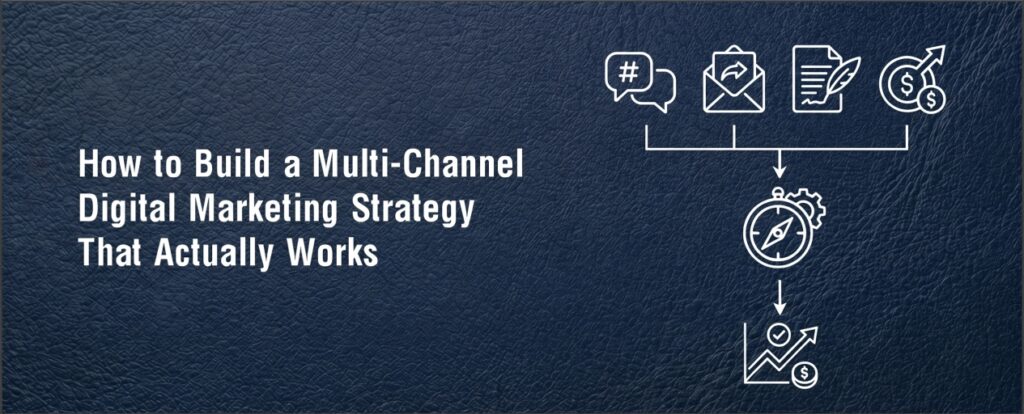
Most businesses understand they should be present on multiple platforms. What far fewer understand is the difference between being present and being strategic. Having a Facebook page, a website, and occasionally posting on Instagram isn’t a multi-channel strategy. It’s scattered activity with no connective tissue.
A genuine multi-channel digital marketing strategy means your customer can discover you through Google, see you on Instagram, read your content on LinkedIn, receive a retargeting ad on Facebook, and open a follow-up email — and every single touchpoint reinforces the same message, moves them forward, and feels intentional. According to research from HubSpot’s Marketing Statistics, brands using three or more coordinated channels achieve 287% higher purchase rates than single-channel approaches. Those using five or more see 412% higher purchase rates.
The data is compelling. The execution is where most businesses stumble. This guide walks through exactly how to build a multi-channel strategy that drives real results rather than just keeping you busy.
Why Single-Channel Thinking No Longer Works
Think about your own purchasing behaviour. You probably don’t discover a product, evaluate it, and buy it in a single session on a single platform. You might see a recommendation on social media, then search for reviews on Google, then compare options on a competitor’s site, then finally buy three days later after an email reminds you about a discount.
Your customers behave exactly the same way. The modern buyer journey spans multiple devices, multiple platforms, and multiple sessions before a decision is made. Single-channel marketing only captures a fraction of those touchpoints, leaving the rest to competitors who do show up consistently.
What makes 2026 different from previous years is the addition of AI-powered discovery to this already complex journey. Customers aren’t just searching on Google anymore. They’re asking ChatGPT, using Perplexity, and getting answers through Google’s AI Overviews. Understanding what Answer Engine Optimization (AEO) is and how it differs from SEO has become essential context for any channel strategy, because visibility now means appearing where AI answers are generated, not just where traditional search results appear.
The Foundation: Know Your Customer Journey First
Before choosing channels, map out how your specific customers discover, evaluate, and decide. Generic channel advice fails because different businesses have genuinely different customer journeys.
A B2B software company might find their customers discover them through LinkedIn content, evaluate through Google searches and case studies, and convert through email nurture sequences. A Shopify fashion brand might get discovery through TikTok and Instagram, evaluation through user-generated content and reviews, and conversion through retargeting ads and abandoned cart emails.
The channels you prioritise should match where your customers actually spend time during each stage of their journey, not where you’re most comfortable or where your competitors happen to be.
Ask yourself three questions before building your channel mix. Where do my ideal customers first discover solutions like mine? Where do they go to evaluate and compare options? What finally pushes them to make a decision or take action? The answers should drive your channel selection, not industry trends or platform popularity statistics.
Building Your Channel Architecture
Once you understand the customer journey, you can build a channel architecture that serves each stage deliberately. Think of it in three layers.
Discovery Channels create awareness with people who don’t yet know you exist. These typically include organic search through strong SEO and topical authority, social media content, paid advertising, and increasingly, visibility in AI-generated answers through Generative Engine Optimization (GEO).
Consideration Channels engage people who are aware of you and evaluating whether you’re the right solution. Email sequences, detailed content marketing, retargeting ads, and case studies all serve this function. Your website’s depth of content matters enormously here, particularly content that demonstrates genuine expertise through strong E-E-A-T signals.
Conversion and Retention Channels close the deal and keep customers coming back. Email remains the highest ROI channel at this stage, with every dollar invested returning an average of $36 according to Litmus research. Social media plays a role here too, particularly platforms where post-purchase communities form and brand loyalty develops.
| Stage | Primary Channels | Supporting Channels | Key Metrics |
|---|---|---|---|
| Discovery | SEO, paid search, social content, AEO | PR, influencer, video | Impressions, reach, new visitors |
| Consideration | Email, retargeting, content marketing | LinkedIn, YouTube, webinars | Engagement rate, time on site, return visits |
| Conversion | Email, paid social, SMS | Live chat, reviews | Conversion rate, cost per acquisition |
| Retention | Email, social community, loyalty programmes | SMS, push notifications | Repeat purchase rate, LTV, NPS |
Content: The Fuel That Powers Every Channel
Here’s a truth that separates effective multi-channel marketers from ineffective ones: content isn’t one channel among many. It’s the fuel that powers all of them.
Your SEO strategy needs content. Your social media needs content. Your email sequences need content. Your paid ads need compelling creative. Your AI visibility depends on content quality and structure. Without a systematic approach to content creation, every channel runs dry.
Understanding what content marketing actually is in 2026 matters more in a multi-channel context than anywhere else because content must work harder across more surfaces simultaneously. A well-written blog post can become an email newsletter, social media posts, short-form video scripts, and the foundation of a paid ad campaign. This repurposing multiplies your return on every piece of content you create.
Technical content structure matters too. Implementing schema markup across your website helps search engines and AI systems understand your content accurately, improving how you appear across multiple discovery channels simultaneously. It’s a single technical investment that supports every other channel.
Social Media in a Multi-Channel Strategy
Social media functions differently in a multi-channel strategy than it does as a standalone tactic. Rather than chasing followers or posting for engagement alone, its role is to serve the broader customer journey at each stage.
Discovery-stage social means creating content that reaches people who don’t follow you yet through shares, hashtags, paid promotion, and algorithm distribution. Consideration-stage social means retargeting website visitors, nurturing followers with valuable content, and building the credibility signals that make people trust you enough to buy. Conversion-stage social means shoppable posts, direct response ads, and time-sensitive offers.
Understanding platform-specific mechanics gives you a real edge here. For example, knowing how the Instagram algorithm works in 2026 allows you to design content that gets distributed beyond your existing audience, expanding your discovery reach without additional ad spend. Platform features like loyalty accounts on Instagram create retention mechanics within social that feed directly into the broader customer relationship.
It’s also worth understanding how social media indirectly helps SEO through social signals and brand mentions, since multi-channel strategies have compounding effects that single-channel analysis typically misses.
| Mistake | Why It Happens | How to Fix It |
|---|---|---|
| Same content on every platform | Efficiency prioritised over effectiveness | Adapt format and tone per platform whilst keeping consistent message |
| No channel coordination | Teams working in silos | Create shared campaign briefs and unified customer journey maps |
| Ignoring AI search channels | Traditional SEO mindset | Add AEO and GEO to existing SEO strategy |
| Measuring channel performance separately | Easier to track individually | Build attribution models that credit the full journey |
| Starting with too many channels | FOMO-driven expansion | Master 2 to 3 channels first before expanding |
Measurement: How to Know What’s Actually Working
The hardest part of multi-channel marketing isn’t execution. It’s attribution. When a customer discovers you on Google, gets retargeted on Instagram, and converts through email, which channel gets credit?
Last-click attribution, still used by many businesses, gives all credit to the final touchpoint before conversion. This dramatically undervalues discovery channels like SEO and social content, causing businesses to over-invest in conversion channels and under-invest in the channels that created the opportunity in the first place.
A more accurate approach uses data-driven attribution models that distribute credit across the touchpoints that genuinely influenced the decision. Google Analytics 4 offers data-driven attribution that analyses your specific conversion patterns. For e-commerce businesses, understanding which channels start journeys versus which close them reveals where your investment creates the most compounding value.
The metrics worth tracking across your multi-channel strategy include new visitor acquisition by channel (reveals discovery performance), assisted conversions by channel (reveals consideration value), direct conversion rate by channel (reveals conversion efficiency), and customer lifetime value by acquisition channel (reveals long-term ROI beyond the first sale).
Putting It Together: A Practical Starting Framework
If you’re building or rebuilding a multi-channel strategy, avoid the temptation to launch everything simultaneously. Spreading attention and budget across six channels from day one means executing all of them poorly.
Start with two to three channels that match your customer journey most directly. Build those properly, establish measurement systems, and generate real results before expanding. A well-executed three-channel strategy outperforms a poorly executed six-channel approach every time.
From there, expand strategically based on data rather than intuition. When a channel demonstrates positive ROI and you have the resources to manage it properly, add it to the mix. When a channel consistently underperforms despite genuine effort and optimisation, don’t be afraid to scale it back.
The businesses winning with multi-channel marketing in 2026 share one characteristic beyond their technical sophistication: they’ve built systems that learn continuously. Every campaign provides data that improves the next one. Every channel interaction teaches them something about their customer journey. Over time, this compounding intelligence creates advantages that are genuinely difficult for competitors to replicate.
At Enovatorz, we build integrated multi-channel strategies for businesses across e-commerce, B2B, and service industries. From Shopify development and Amazon marketplace management to SEO, paid advertising, and social media marketing, our team combines technical execution with strategic thinking to build digital marketing systems that grow alongside your business. If you’re ready to move beyond scattered tactics and build a strategy that actually connects, get in touch with our team today.
