
The landscape of search has fundamentally transformed. Traditional SEO tactics that worked just two years ago are rapidly becoming obsolete as artificial intelligence reshapes how people discover, evaluate, and choose brands online.
In 2026, visibility isn’t just about ranking on page one of Google. It’s about being present, trusted, and recommended across AI-powered search engines, large language models, voice assistants, and decision-making platforms that users increasingly rely on to navigate an overwhelming digital ecosystem.
For businesses, this shift presents both a challenge and an opportunity. Those who adapt their brand presence and SEO strategies for this AI-first internet will capture disproportionate visibility and market share. Those who don’t risk becoming invisible, regardless of how good their products or services actually are.
The Evolution from Search Engines to Decision Engines
Search engines have evolved from simple information retrieval systems into sophisticated decision-making platforms. When someone searches today, they’re not just looking for a list of links—they’re looking for answers, comparisons, recommendations, and trustworthy guidance.
AI systems now power these decision engines, fundamentally changing how search results are generated and presented. Instead of displaying ten blue links and letting users sort through them, modern search engines synthesize information, compare options, and often provide direct answers without requiring a click to any website.
This evolution has created what industry experts call “zero-click searches”—queries where users get their answer directly on the search results page. For businesses, this means traditional metrics like click-through rates and page visits are becoming less reliable indicators of visibility and impact.
What matters now is whether your brand appears in these AI-generated summaries, whether you’re cited as a trusted source, and whether AI systems recognize your business as an authority worth recommending.
How AI Systems Evaluate and Recommend Brands
Understanding how AI evaluates brands is crucial for modern SEO strategy. Unlike traditional algorithms that primarily focused on keywords and backlinks, AI systems assess brands through a more holistic lens.
| Evaluation Factor | What AI Looks For | Impact on Visibility | How to Optimize |
| Brand Recognition | Consistent mentions across platforms, clear identity | High – determines if brand is “known” entity | Maintain consistent NAP, messaging, visual identity across all channels |
| Topical Authority | Depth of content in specific domain, expertise signals | Very High – determines trustworthiness | Create comprehensive, interconnected content clusters on core topics |
| Credibility Signals | Third-party validation, reviews, citations, mentions | High – validates authority claims | Build genuine reviews, earn media mentions, establish thought leadership |
| Content Quality | Originality, depth, accuracy, helpfulness | Very High – determines content value | Invest in unique insights, data, research, and expert perspectives |
| User Experience | Site speed, mobile optimization, clear navigation | Medium – affects recommendation likelihood | Optimize technical performance and usability |
| Consistency | Uniform messaging, positioning, voice across touchpoints | High – reinforces brand identity | Develop and follow brand guidelines across all content |
| Contextual Relevance | Alignment with user intent and query context | Very High – determines matching accuracy | Structure content to directly address user needs and questions |
AI doesn’t just look at individual pages—it builds a comprehensive understanding of your entire brand ecosystem. This holistic evaluation means every piece of content, every mention, every review contributes to or detracts from your overall brand authority in AI systems.
The Rise of Brand-Centric SEO
The shift toward brand-centric SEO represents a fundamental change in how businesses need to approach visibility. Traditional SEO focused heavily on technical optimization and keyword targeting. While these elements remain important, they’re no longer sufficient on their own.
Modern SEO success requires building a recognizable, trustworthy brand that AI systems can understand and confidently recommend. This means your SEO strategy must integrate with your branding, content marketing, and overall business positioning.
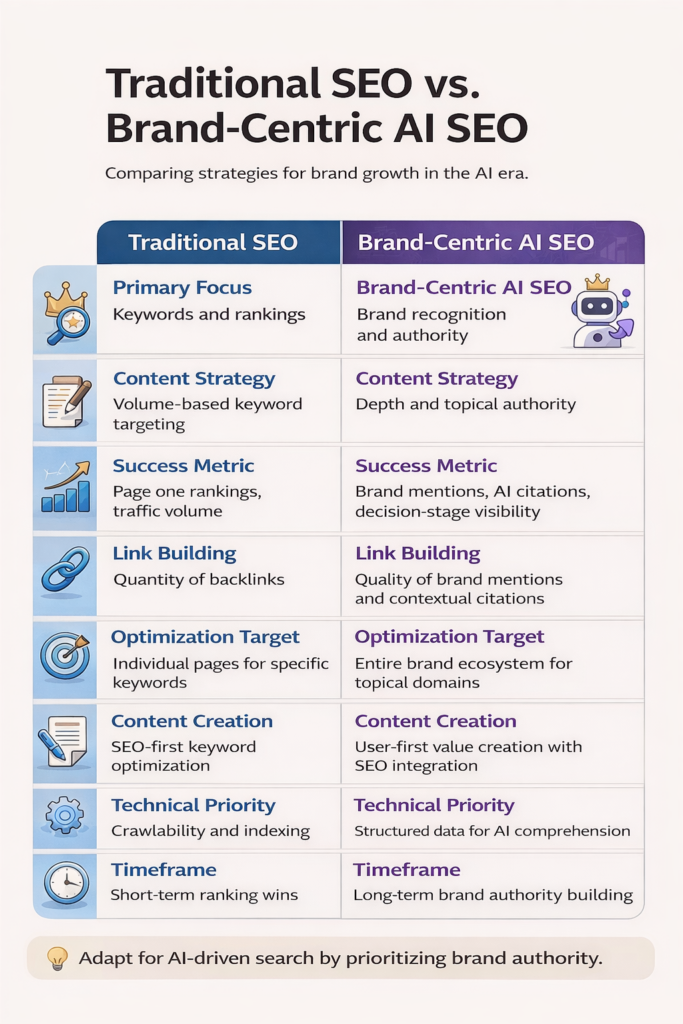
This shift doesn’t mean abandoning traditional SEO best practices. Technical optimization, keyword research, and link building still matter. But they must now serve a larger brand-building strategy rather than exist as isolated tactics.
Understanding E-E-A-T in the AI Era
Google’s E-E-A-T framework (Experience, Expertise, Authoritativeness, and Trustworthiness) has become increasingly central to SEO success, particularly as AI systems become more sophisticated at evaluating content quality and source credibility.
E-E-A-T isn’t just a ranking factor—it’s a framework for how AI systems determine which sources deserve visibility and recommendation. According to Search Engine Journal’s comprehensive guide on E-E-A-T, demonstrating these qualities directly impacts how search engines and AI platforms assess and rank content.
Breaking Down E-E-A-T Components:
- Experience: First-hand knowledge and practical insights that demonstrate real-world involvement with the topic. This is what separates generic content from genuinely valuable guidance.
- Expertise: Subject matter depth that shows specialized knowledge. This comes from credentials, demonstrated knowledge, and the ability to explain complex topics clearly and accurately.
- Authoritativeness: Recognition within your industry or niche as a go-to source. This is built through consistent high-quality content, citations from other authoritative sources, and establishing thought leadership.
- Trustworthiness: Reliability, transparency, and credibility that makes users and AI systems confident in your information. This includes accurate citations, clear sourcing, transparent business practices, and positive reputation signals. Google’s Evaluator Guidelines provide detailed frameworks for how quality and trust are assessed in search results.
For businesses, strengthening E-E-A-T requires a comprehensive approach that goes beyond individual content pieces to encompass your entire brand presence and reputation.
AI Traffic Patterns and Brand Visibility
Recent research reveals significant insights into how AI-driven traffic differs from traditional search traffic. According to Previsible’s 2025 State of AI Discovery Report, AI referral traffic shows distinct patterns that favor certain types of content and brand touchpoints.
AI Traffic Distribution Insights:
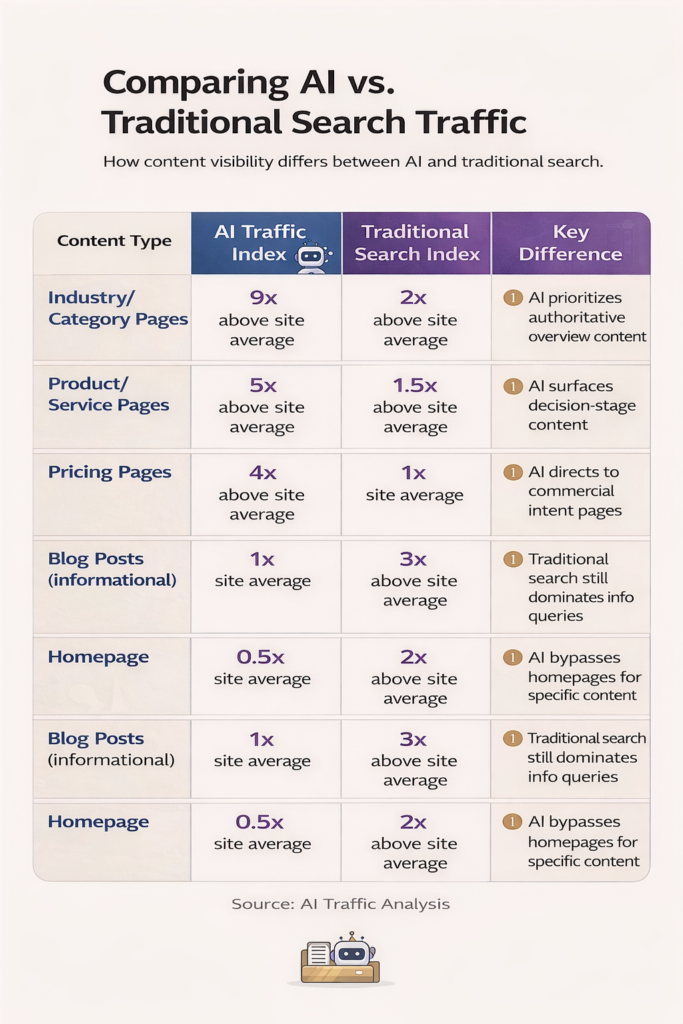
The data shows that AI traffic is significantly more intent-rich and conversion-oriented than traditional search traffic. Rather than broad informational queries, AI systems direct users to specific pages that match their decision-making needs.
This has major implications for content strategy. While traditional SEO might prioritize high-volume informational content to capture top-of-funnel traffic, AI-optimized strategies should focus on authoritative, decision-stage content that helps users make informed choices.
ChatGPT alone accounts for approximately 84% of all AI referral traffic, growing more than 3x year over year. This concentration means that optimizing for AI visibility increasingly means optimizing for how large language models understand and recommend brands.
Brand Signals That Matter for AI Visibility
AI systems evaluate brands through multiple signals across various digital touchpoints. Understanding which signals carry the most weight helps prioritize optimization efforts.
Critical Brand Signals for AI Systems:
1. Consistent Business Information
AI systems struggle with inconsistent data. When your business name, address, phone number, or service descriptions vary across platforms, it creates confusion that reduces AI confidence in recommending your brand.
Ensure NAP (Name, Address, Phone) consistency across your website, Google Business Profile, directories, social platforms, and any other online presence. This seemingly simple factor significantly impacts how AI systems understand and categorize your business.
2. Brand Mention Context
AI doesn’t just count brand mentions—it evaluates the context in which your brand appears. Mentions in authoritative publications, industry reports, or alongside other respected brands carry more weight than random citations.
Focus on earning quality mentions through thought leadership, expert contributions, partnerships, and genuine value creation rather than purely link-building tactics.
3. Content Depth and Interconnection
AI systems favor brands that demonstrate deep expertise in specific domains. This means comprehensive, interconnected content that thoroughly covers your area of focus performs better than scattered, surface-level pieces.
Create content clusters where pillar pages provide comprehensive overviews and supporting content explores specific aspects in detail, all linked together to show topical authority.
4. User Engagement Signals
How users interact with your content sends signals to AI systems about quality and value. Metrics like time on page, scroll depth, return visits, and social sharing all contribute to AI’s understanding of content value.
While you can’t directly manipulate these signals, creating genuinely valuable content that meets user needs naturally generates positive engagement patterns.
5. Third-Party Validation
Reviews, ratings, testimonials, case studies, and independent verification all serve as trust signals that AI systems factor into brand evaluation. The source credibility of these validations matters—verified reviews on established platforms carry more weight than unverified testimonials on your own site.
6. Structured Data Implementation
Schema markup and other structured data formats help AI systems understand your content, services, and expertise more accurately. Proper implementation makes it easier for AI to extract relevant information and include your brand in appropriate recommendations.
Content Strategies for AI Visibility
Creating content that performs well in AI-driven search requires different approaches than traditional SEO content. The focus shifts from keyword optimization to comprehensive value creation that establishes authority.
AI-Optimized Content Characteristics:
- Clarity and Structure: AI systems prioritize content that’s well-organized, clearly written, and easy to parse. Use descriptive headings, logical flow, and clear language that both humans and AI can easily understand.
- Comprehensive Coverage: Rather than creating multiple thin pieces targeting keyword variations, develop comprehensive resources that thoroughly address topics. AI systems recognize and reward depth over breadth.
- Original Insights and Data: Generic, rehashed information gets deprioritized. Content that offers unique perspectives, original research, or proprietary data stands out and earns citations and recommendations.
- Direct Answer Provision: Structure content to directly answer questions. Use clear, concise answers followed by supporting detail. This format works well for featured snippets and AI-generated summaries.
- Contextual Relevance: AI evaluates content in context of user intent. Create content that addresses the underlying needs and questions users have, not just the literal keywords they might type.
- Expert Attribution: When appropriate, attribute insights to named experts with established credentials. This strengthens E-E-A-T signals and increases AI confidence in your content.
Technical Optimization for AI Comprehension
While content quality drives AI visibility, technical optimization ensures AI systems can properly access, understand, and utilize your content.
Technical SEO Priorities for AI:
| Technical Element | AI Impact | Implementation Priority | Common Issues |
|---|---|---|---|
| Structured Data (Schema) | Very High – enables AI to extract specific information accurately | Critical | Missing markup, incorrect schema types, validation errors |
| Site Speed | High – affects crawl efficiency and user experience signals | High | Large images, excessive scripts, poor hosting |
| Mobile Optimization | High – mobile-first indexing affects AI access to content | Critical | Non-responsive design, mobile usability issues |
| XML Sitemap | Medium – helps AI discover and understand site structure | High | Outdated sitemap, missing pages, incorrect priority signals |
| Internal Linking | High – shows content relationships and topical clusters | High | Weak linking, orphaned pages, unclear hierarchy |
| Clean URL Structure | Medium – aids AI in understanding page topics | Medium | Dynamic parameters, unclear naming, excessive length |
| HTTPS Security | Medium – trust signal for AI and users | Critical | Mixed content, expired certificates |
| Canonical Tags | Medium – prevents AI confusion from duplicate content | High | Missing tags, self-referencing errors, incorrect implementation |
Technical optimization doesn’t just help AI find your content—it helps AI understand the context, relationships, and authority of your content within your broader site structure.
Local SEO in an AI-Driven World
Local businesses face unique challenges and opportunities in AI-driven search. AI systems increasingly power local search results and recommendations, changing how consumers discover local services.
AI Impact on Local Search:
- Voice assistants, AI chatbots, and location-based recommendations now handle significant portions of local search queries. These systems don’t show traditional search results—they make direct recommendations based on location, reviews, and relevance.
- For local businesses, this means:
- Comprehensive Google Business Profile optimization becomes even more critical. AI systems pull heavily from Google Business Profile data for local recommendations. Complete, accurate, regularly updated profiles with photos, posts, and responses to reviews signal active, engaged businesses.
- Review quality and recency matter more than ever. AI doesn’t just look at star ratings—it analyzes review content for insights into business strengths, weaknesses, and customer satisfaction patterns. Recent reviews carry more weight than older ones.
- Local content that demonstrates community connection helps AI systems understand your local relevance. Content featuring local events, partnerships, community involvement, and area-specific expertise strengthens local authority signals.
- Consistent location data across all platforms prevents AI confusion. Variations in address, phone number, or business hours across different sources reduce AI confidence in your business information.
E-Commerce Brand Optimization for AI Recommendations
E-commerce brands face particularly intense AI-driven competition. Product recommendations, price comparisons, and alternative suggestions powered by AI significantly influence purchase decisions.
E-Commerce AI Optimization Strategies:
- Detailed Product Information: AI systems favor comprehensive product descriptions that include specifications, use cases, benefits, and contextual information. Generic manufacturer descriptions get deprioritized.
- Unique Product Content: Even when selling common products, unique descriptions, buying guides, and usage tips help AI distinguish your offerings and increase recommendation likelihood.
- Clear Product Categorization: Proper category structure and product taxonomy help AI understand what you sell and match products to relevant queries.
- Customer Review Integration: Product reviews serve as crucial trust and quality signals. Encourage authentic reviews and respond to both positive and negative feedback.
- Product Schema Implementation: Structured data for products, reviews, pricing, and availability enables AI systems to accurately extract and present your product information.
- Comparison Content: Create comparison guides that help users choose between your products or understand how your offerings compare to alternatives. AI systems frequently cite these resources.
Measuring AI Visibility and Brand Performance
Traditional SEO metrics don’t fully capture AI visibility performance. New measurement approaches are needed to understand how effectively your brand appears in AI-driven search and recommendations.
AI Visibility Metrics to Track:
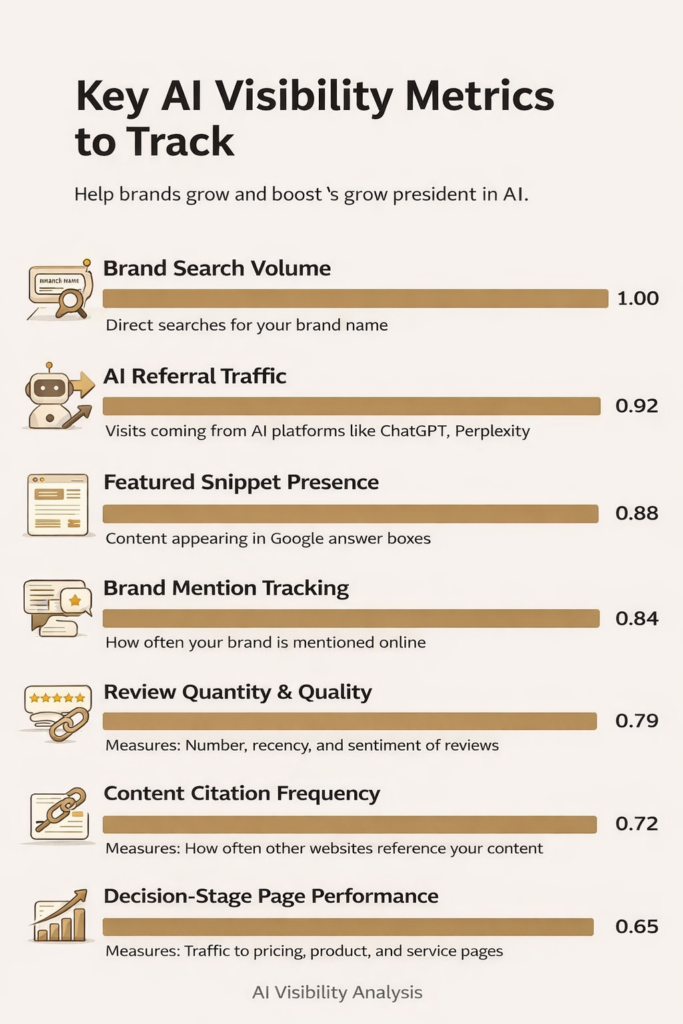
These metrics provide a more complete picture of how AI systems perceive and recommend your brand compared to traditional ranking-focused metrics.
The Human Element in AI-Optimized SEO
Despite AI’s growing influence, human expertise and judgment remain irreplaceable in creating content that performs well in AI-driven search. AI can assist with research, analysis, and efficiency, but it can’t replicate the nuanced understanding, original thinking, and authentic expertise that establishes genuine authority.
Why Human-Led Content Outperforms AI-Generated Content:
- Original Perspectives: AI synthesizes existing information but struggles to generate truly novel insights. Human experts can identify gaps, challenge assumptions, and offer unique viewpoints that establish thought leadership.
- Contextual Nuance: Understanding industry-specific context, regulatory nuances, and practical implementation challenges requires experience that AI lacks.
- Credibility and Trust: Content attributed to real experts with verifiable credentials carries more weight with both users and AI systems than anonymous AI-generated text.
- Strategic Judgment: Determining what content to create, how to position it, and what messages to emphasize requires strategic thinking that AI cannot replicate.
The most effective approach combines human expertise with AI assistance—using AI tools for research, data analysis, and efficiency while keeping humans responsible for strategy, judgment, and final content quality.
Implementing an AI-Ready Brand Strategy
Transitioning to an AI-optimized brand strategy requires coordinated efforts across multiple business functions—not just marketing and SEO teams.
Key Implementation Steps:
- Brand Audit and Consistency Review: Assess current brand presence across all digital touchpoints. Identify inconsistencies in messaging, visual identity, business information, and positioning. Create and enforce brand guidelines to ensure consistency.
- Content Inventory and Gap Analysis : Evaluate existing content against AI visibility criteria. Identify gaps in topical coverage, opportunities to deepen authority, and content that needs updating or consolidation.
- Technical Foundation Strengthening: Ensure technical infrastructure supports AI comprehension through proper structured data, site speed optimization, mobile responsiveness, and clear site architecture.
- Review and Reputation Building:Develop systematic processes for encouraging, collecting, and responding to customer reviews across relevant platforms.
- Thought Leadership Program Development: Create consistent publication schedules for expert content, industry insights, and original research that builds authority over time.
- Measurement Framework Implementation: Establish tracking for AI-specific metrics alongside traditional SEO KPIs to measure progress and identify optimization opportunities.
The Future of Brand Visibility in AI Search
AI’s influence on search and discovery will only accelerate. Understanding likely developments helps businesses prepare for what’s coming.
Emerging Trends to Watch:
- Increased AI Mediation: More searches will be mediated through AI systems that synthesize and recommend rather than just listing results. Direct brand visibility in these AI-generated responses becomes crucial.
- Multimodal Search: AI systems increasingly understand images, video, audio, and text together. Brands need presence across content formats.
- Personalized AI Recommendations: AI will deliver increasingly personalized search results and recommendations based on user history, preferences, and context. Building broad brand recognition helps ensure inclusion in personalized results.
- Real-Time Brand Evaluation: AI systems will evaluate brand reputation, sentiment, and authority in real-time based on latest reviews, mentions, and content. This makes consistent brand management critical.
- Voice and Conversational Search Growth: As voice assistants and chatbots handle more queries, optimization for conversational, direct-answer content becomes essential.
Conclusion
The evolution toward AI-driven search and discovery represents a fundamental shift in how brands achieve visibility and reach customers. Success in this new landscape requires moving beyond traditional SEO tactics toward comprehensive brand-building strategies that establish recognition, authority, and trust across the digital ecosystem.
Brands that invest in genuine expertise, consistent messaging, quality content, and technical excellence will capture disproportionate visibility as AI systems become the primary gatekeepers of information and recommendations. Those that rely on outdated SEO tactics or try to game AI systems will find themselves increasingly marginalized.
For businesses ready to adapt to this AI-first internet, the opportunity is significant. Early movers who establish strong brand signals and topical authority will benefit from compounding advantages as AI systems continue evolving and mediating more of the discovery process.
The question isn’t whether to adapt to AI-driven search, but how quickly and effectively your brand can make the transition. The brands that act now will define the competitive landscape for years to come.
Ready to strengthen your brand’s AI visibility? Contact Enovatorz to develop a comprehensive SEO and brand strategy designed for the AI-first internet.
